Mardi Himal Trek
75 reviews in Tripadvisor
Trip Duration
12 DaysDestination
NepalMax. Altitude
4,500 m.Trip Difficulty
ModerateGroup Size
1-12Transportation
Tourist VehicleAccommodation
Hotel/TeahouseActivity
Trekking/HikingMeals
All inclusiveStart / End
KathmanduRegion
Annapurna RegionBest Season
Spring, AutumnUS$ 930
Need Help? Talk to Expert
+977 9764792172Trip Overview
The Mardi Himal Trek is a well-hidden secret in the Annapurna range of Nepal. The Mardi Himal Trek is not just about trekking through the diverse terrain of the region, it also provides trekkers with cultural experiences, beautiful views of the mountains, and much more.
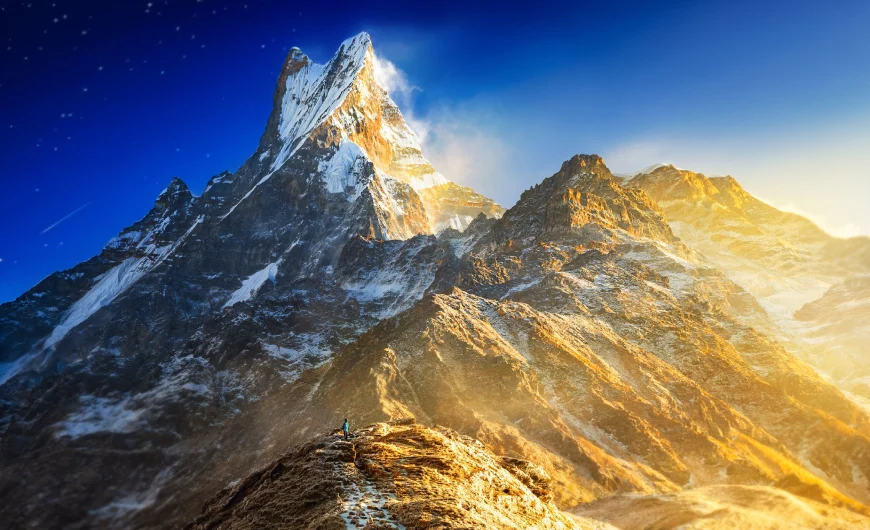
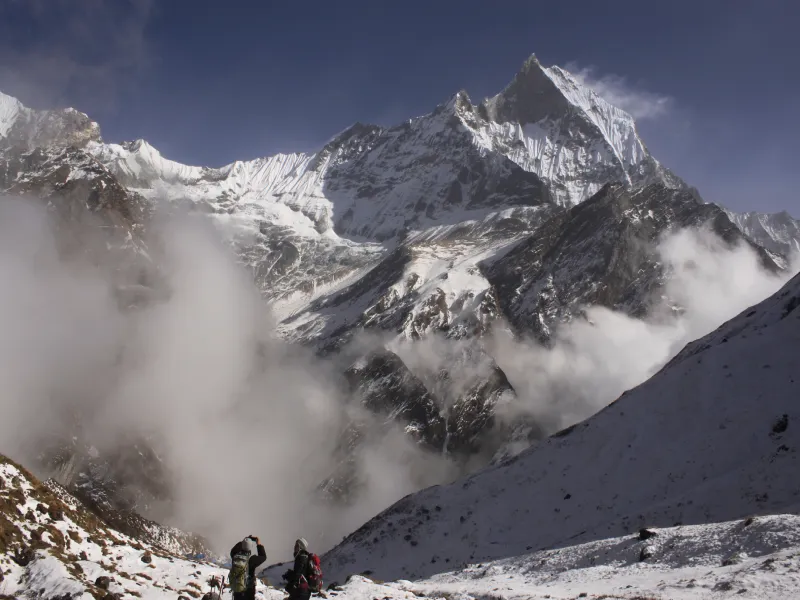
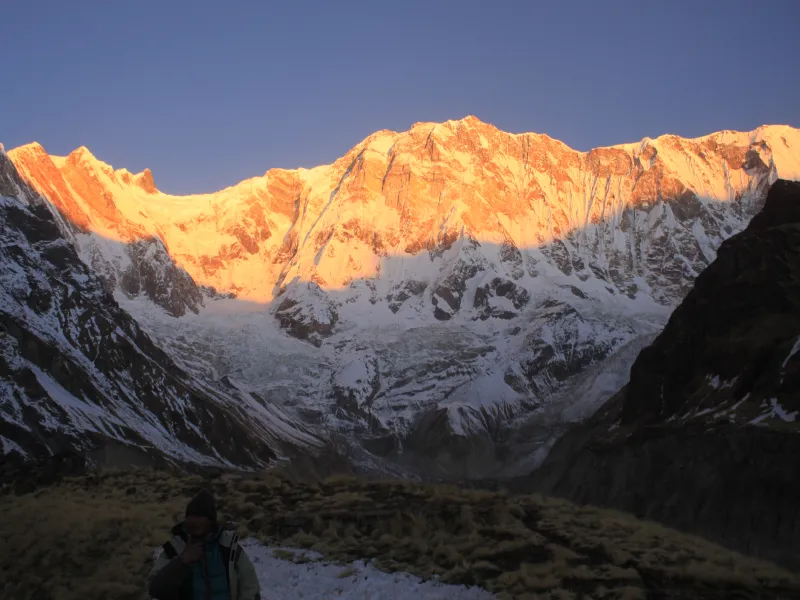
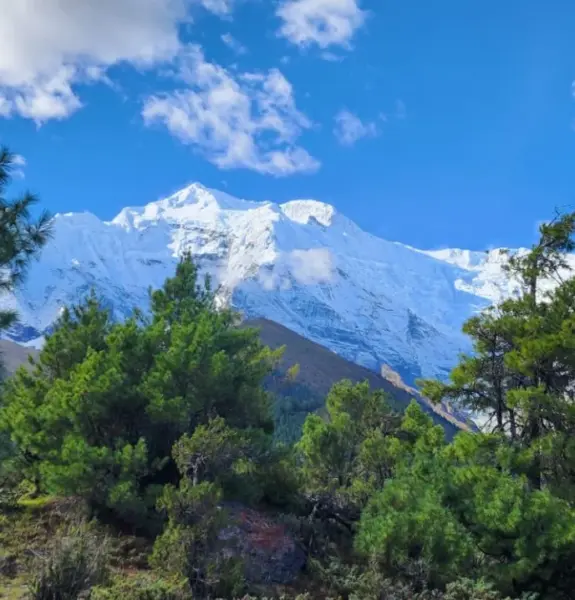
The Mardi Himal Trek provides unparalleled panoramic views of the Annapurna Range, including Machhapuchhre (Fishtail), Annapurna South, and Hiunchuli. The vantage points on this Mardi Himal trek offer some of the best scenic mountain views in Nepal, making it a top choice for those seeking a spectacular Himalayan adventure.
As for the end point, it is a Mardi Himal Base Camp, located some 4,500 meters above the sea level. The trek itself does not require years of previous experience in walking long distances through mountains. As for one’s physical condition, it should be rather good because there will be several tough climbs along the way.
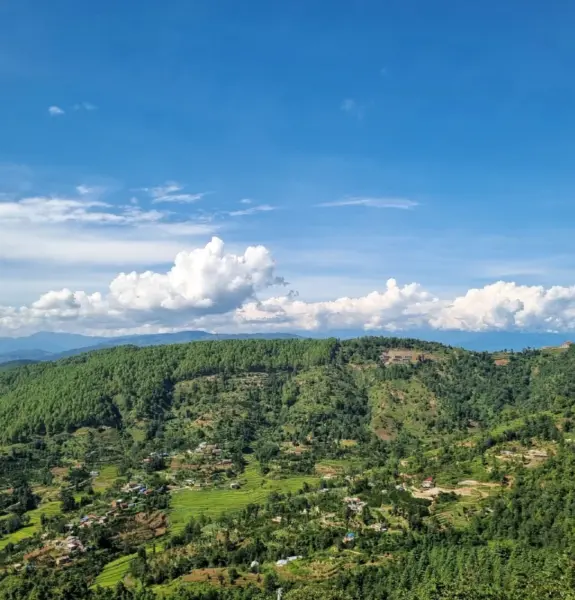
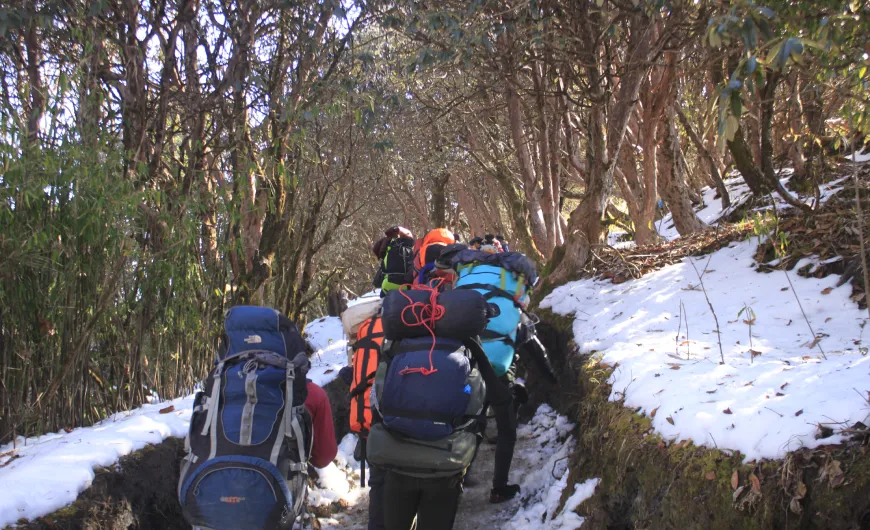
It is the diversity that will appeal to most hikers. You get to experience areas which seem more like a jungle as far as the vegetation and bird singing goes. As you continue hiking, you start feeling drier conditions while getting closer to ridges, where you can see Machapuchare face to face.
Mardi Himal Trek gives the opportunity to stay overnight at local Gurung villages. Simple tea houses and friendly villagers make your adventure even more special.
This Mardi Himal Trek Itinerary presents you with the complete guide for trekking to Mardi Himal. You will find all the necessary information including the itinerary, permits, cost, season recommendations, etc.
Mardi Himal Trek Route
It is a relatively easy trek that involves a ridge trail within the Annapurna Conservation Area. It is not a circuit in the classical meaning since you move up via one trail and descend via another one, making this trip even more interesting.
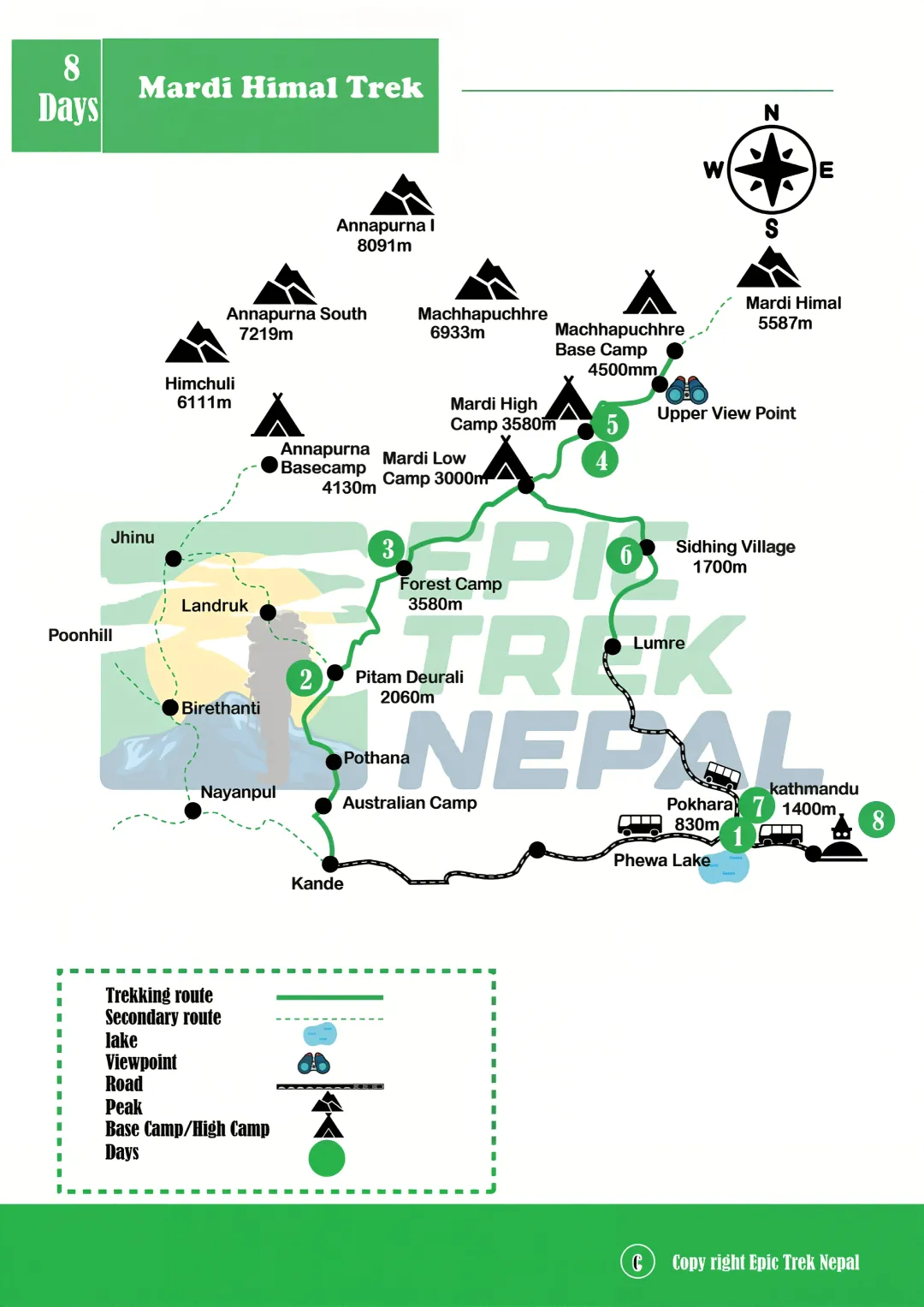
Your adventure begins in Kathmandu. Having spent one day in the city and having explored its beauty, you start traveling towards Pokhara. Next, you head for Kande, the beginning point of your real adventure.
Your next steps involve moving through the forest area towards Pitam Deurali and then ascending to the High Camp and Forest Camp.
Day 7 of your trip brings you to Mardi Himal Base Camp, which is the key point of your journey. The view from here is amazing and breathtaking. After enjoying this place and taking some nice pictures, you go back to the High Camp.
On the next two days, you descend via Sidhing and Lumhre until reaching Pokhara. Next, you spend a day in this city and then move to Kathmandu where you can have a rest after your tiring adventure.
Thus, the whole journey lasts 12 days including arrival and departure days. Your body gets enough time to adapt to the new conditions.
Who can Join the Mardi Himal Trek
Unlike mountaineering expeditions, the Mardi Himal Trek does not call for technical mountaineering experience. You don’t have to bring crampons, ropes, or high altitude expertise. However, participants should be in good physical condition and must want to hike up the mountain each day.
If you can hike for 5 to 6 hours each day with a backpack, then you meet the basic requirement for this trekking adventure. While the trekking trail is steep in spots, such as from Forest Camp to High Camp, there is no reason why you cannot do it with proper pacing.
Age is also not an issue. Trekkers who are in their fifties and sixties have successfully completed this trekking experience. Likewise, trekkers in their twenties are enthusiastic about this adventure. Adolescents who have some trekking experience can also join.
This trek is taken by newcomers to the world of trekking each season. All that is needed from you is a little preparation in advance – some cardio exercises and some hiking trips, and that’s it.
It will only be not recommended for individuals who suffer from severe diseases of the cardiovascular system or pulmonary system to refrain from this trip since the camp located near Mardi Himal reaches an altitude of 4500 meters above sea level.
In general, you can undertake the Mardi Himal view trek if you are a person in good health and ready for mountain activities.
Highlights of Mardi Himal Trek
- Stunning views of mountains like Annapurna (8,091m), Dhaulagiri (8,167 m), Fishtail (6,993 m), Hiunchuli (6,441 m), and others
- Known for its beautiful views and less crowded paths – Hidden gem
- Trek goes through the famous rhododendron forests of Nepal
- Early morning trek to viewpoint for witness 360-degree panoramic sunrise views
- Experience in the hot springs in Jhinu Danda
- Budget-friendly treks and is one of the easy to moderate-level treks in the Annapurna region
Photo Gallery & Video Gallery
Mardi Himal Trek - Distance, Duration, and Altitude
| Trekking Route | Distance (Kilometers) | Duration (Hours) | Altitude (Meters) |
|---|---|---|---|
| Kande to Pitam Deurali | 8 KM | 4 to 5 hours | 2100 m. |
| Pitam Deurali to Forest Camp | 7 KM | 5 to 6 hours | 2550 m. |
| Forest Camp to High Camp | 8 KM | 4 to 5 hours | 3580 m. |
| High Camp to Mardi Base Camp and back | 10 KM | 7 to 8 hours | 4500 m. |
| High Camp to Sidhing | 9 KM | 5 to 6 hours | 3580 m. |
| Sidhing to Lumhre and Drive back to Pokhara | 9 KM | 4 to 5 hours | 2600 m. |
Itinerary of Mardi Himal Trek
Day 01: Arrival in Kathmandu
Welcome to the bustling capital of Nepal, Kathmandu. Upon your arrival at Tribhuvan International Airport, our friendly representative will be there to greet you. They’ll assist you to escort to your designated hotel. Take some time to relax and refresh after your journey.
Activity: 35 min drive
Max. Altitude: 1324m./4,344ft. (Kathmandu)
Accommodation: 3 Star Hotel
Day 02: Explore Kathmandu
Kathmandu, explore a city that blends art, culture, history, and religion. Visit some of the city’s most renowned UNESCO World Heritage Sites such as Swayambhunath Stupa (Monkey Temple), Boudhanath Stupa, Pashupatinath Temple, and Kathmandu Durbar Square with your local provided guide. In the afternoon, enjoy a leisurely walk around the main tourist hub of Kathmandu. Begin preparations for your upcoming trek, ensuring you’re well-equipped for the adventure.
Max. Altitude: 1324m./4,344ft. (Kathmandu)
Meal: Breakfast
Accommodation: 3 Star Hotel
Day 03: Drive from Kathmandu to Pokhara
Your journey begins with a early drive to the captivating city of Pokhara. Located at an elevation of 822 meters, Pokhara is one of Nepal’s most sought-after tourist destinations. Its serene lakes, lush surroundings, and awe-inspiring backdrop of snow-capped peaks. Upon arrival, check in to your hotel and soak yourself in the natural beauty of Pokhara.
Activity: 5-6 hours
Max. Altitude: 822m./2,697ft. (Pokhara)
Meal: Breakfast, Lunch, Dinner
Accommodation: Standard Hotel
Day 04: Drive to Kande, and Trek to Pitam Deurali
After a scenic drive from Pokhara to Kande, you’ll arrive at the starting point of your trek. The trail leads you through enchanting forests to Australian Camp, an ideal vantage point to witness the Annapurna and Fishtail mountain ranges. Continuing from Australian Camp, you’ll embark on a gentle climb to reach Pitam Deurali via Pothana. En route, marvel at the breathtaking vistas of the Fishtail and Annapurna Mountains. Your night will be spent at Pitam Deurali (2100m).
Activity: 1 hour drive and 3-4 hours trek
Max. Altitude: 2100m./6,890ft. (Pitam Deurali)
Meal: Breakfast, Lunch, Dinner
Accommodation: Standard Teahouse
Day 05: Trek to Forest Camp
The day’s journey takes you through mixed forests, offering a gradual uphill trail. You’ll find yourself surrounded by the tranquility of nature. Reach your destination for the day, Forest Camp (2550m), where you’ll stay overnight in a cozy tea house.
Activity: 5 hours
Max. Altitude: 2600m./8,530ft. (Forest Camp)
Meal: Breakfast, Lunch, Dinner
Accommodation: Standard Teahouse
Day 06: Trek to High Camp
Wake up to witness a clear views of the Fishtail Mountain. After breakfast, leaving the dense jungle behind, you’ll continue your journey with a gradual uphill trail along the carpeted ridges and slopes. Along the way, soak in the breathtaking vistas of Annapurna, Dhaulagiri, and more. As the day comes to a close, you’ll reach High Camp, where you’ll spend the night in a tea house.
Activity: 5-6 hours
Max. Altitude: 3600m./11,811ft. (High Camp)
Meal: Breakfast, Lunch, Dinner
Accommodation: Teahouse
Day 07: Hike to Mardi Himal Base Camp and trek back to High Camp
Today’s adventure begins a little earlier than usual. The trail starts with a leisurely walk, featuring some steep steps and ridges. Upon reaching the Mardi Himal Base Camp, you’ll be greeted by a jaw-dropping panorama. Take your time to explore the area and absorb the majestic views of Annapurna, Dhaulagiri, Fishtail, Hiunchuli, Gangapurna, and the prominent Mardi Himal. Afterward, you’ll descend to High Camp for a comfortable night’s rest.
Activity: 7-8 hours
Max. Altitude: 4500m./14,764ft. (Mardi Himal Base Camp)
Meal: Breakfast, Lunch, Dinner
Accommodation: Standard Teahouse
Day 08: Trek to Sidhing
Today is the day when you start your descend toward Sidhing, through quite tranquil forests and local villages. The downhill trek is much easier but just as scenic, which gives you enough time to enjoy the surrounding vistas. You will get to interact with people and learn of their simple way of life in the mountains.
Activity: 5-6 hours
Max. Altitude: 2599m./8,527ft. (Forest Camp`)
Meal: Breakfast, Lunch, Dinner
Accommodation: Standard teahouse
Day 09: Trek to Lumhre and Drive back to Pokhara
Your final day of trekking in Mardi Himal route, with a steep downhill trail. Continue your descending journey to Lumhre, from where your vehicle will pick you up. After reaching Pokhara you can just relax on the lakeside. Later in the evening, explore Lakeside, an area full of amusement, or sit around a café or simply enjoy an evening boat ride on Phewa Lake.
Activity: 4-5 hours
Max. Altitude: 822m./2,697ft. (Pokhara)
Meal: Breakfast, Lunch, Dinner
Accommodation: Standard Hotel
Day 10: Explore Pokhara
With your accomplishment to Mardi Himal, it’s time to explore the magnificent city of Pokhara. Discover Pokhara’s natural beauty with visits to the World Peace Stupa, incredible caves, serene lakes, and the Barahi Temple situated in the middle of Fewa Lake. This day is yours to enjoy at your own pace.
Max. Altitude: 822m./2,697ft. (Pokhara)
Meal: Breakfast, Lunch, Dinner
Accommodation: Standard Hotel
Day 11: Drive Back to Kathmandu
Early in the morning, you’ll commence your journey back to Kathmandu. Take this time to reflect on the unforgettable experiences and memories you’ve created while trekking on Mardi Himal Base Camp. Your night will be spent in Kathmandu.
Activity: 7-8 hours drive
Max. Altitude: 1324m./4,344ft. (Kathmandu)
Meal: Breakfast, Lunch, Dinner
Accommodation: 3 star Hotel
Day 12: Departure
As your adventure in Nepal draws to a close, you’ll drive to the airport by our representative for your scheduled departure flight. Up until next visit, bid farewell and have a safe flight!
Activity: 35 min drive
Meal: Breakfast
Includes/Excludes
What is included?
- Permits and Fees: All necessary permits for the Annapurna Base Camp trek, such as the Annapurna Conservation Area Permit (ACAP) and the TIMS (Trekkers’ Information Management System) card.
- Accommodation: Accommodation during the trek, typically in teahouses or lodges. This usually includes accommodation in Kathmandu and Pokhara before and after the trek in 3 star hotel on BB plan. (twin sharing basis)
- Meals: Most packages will include three meals a day (breakfast, lunch, and dinner) and it also includes two times hot beverage (in breakfast and lunch) and seasonal fruits after dinner.
- Transportation: Ground transportation from Kathmandu to Pokhara and from Pokhara to the trailhead (usually Australian camp) and back.
- Guide and Porter: Services of an experienced English-speaking trekking guide and porter to carry luggage. This includes their salary, insurance, equipment, food, and accommodation.
- First Aid Kit: A basic first aid kit.
- Equipment: Duffle Bag, Sleeping Bag (if necessary)
- Pick up drop-off : airport pick up and drop-off by private vehicle
What is not included?
- International Flights: International airfare to and from Nepal is not included.
- Travel Insurance: Travel insurance that covers emergency rescue and evacuation is not included, and you’ll be expected to have your own.
- Personal Expenses: Expenses for extra meals, drinks, snacks, charging devices, hot showers, Wi-Fi, and other personal costs are not included.
- Nepal Visa Fees: Entry visa fees for Nepal.
- Additional Accommodation and Meals: If you choose to extend your stay in Nepal, the cost of additional accommodation and meals will not be included.
- Rescue and Evacuation: Any costs related to emergency evacuation or rescues are not covered.
- Trekking Gear: Personal trekking equipment, such as hiking boots, down jackets, trekking poles, and other gear are not included.
- Tips: Tips for guides and porters are not included and are left to your discretion.
Trip Map of Mardi Himal Trek
Trip Information
How Difficult is Mardi Himal Trek?
This trek is considered to be moderately difficult and not an easy one-day excursion. It doesn’t require any special skills like other technical peaks such as Island Peak or Thorong La Pass crossing.
First of all, this Mardi Himal Trek Itinerary route includes gradual climbing over several days from Kande to High Camp. The section from Forest Camp to High Camp seems to be the steepest of all. However, this trekking route is well marked, and there is no need to worry about getting lost.
Another important point that needs mention is altitude. The Mardi Himal Base Camp reaches about 4,500 meters of altitude, and some people feel mild symptoms of AMS here. The trek itself allows for proper acclimatization, so it is important to follow the schedule and not to hurry.
Finally, weather conditions might cause certain difficulties, especially during the rainy season when it could snow heavily in the highlands. Thus, it is necessary to be well-equipped to survive the cold climate of Nepal.
Overall, despite being a physically demanding activity, the majority of tourists cope much easier than expected.
Preparation or the Mardi Himal Trek
Although there are no special athletic requirements for the Mardi Himal Trek, being prepared for the trek will certainly help you a lot. Ideally, you should start preparing six-eight weeks prior to your trek date.
Cardio exercises should come first. You may either run, cycle or swim, whatever suits you. Try to perform at least four times per week. Stair climbing exercise can be especially helpful due to its similarity with uphill trekking.
Strength training is beneficial too, specifically leg and core muscles training. Strong quadriceps and ankle joints will ensure easy and comfortable descending during the hike.
It would be good to undertake several test hikes in your trekking shoes before the trek. This measure will prevent you from blisters formation while you are trekking.
Mentally, try to get ready for a simpler lifestyle than usual. The tea house rooms will not be very cozy. Hot water might not be available at some higher altitude campsites. Moreover, internet connection will often become unavailable along the route. Getting prepared for such inconveniences ahead will allow you to enjoy them.
Remember to pack properly, keep fit and have realistic expectations.
Language & Communication
The official language of Nepal is Nepali, yet, honestly speaking, there shouldn’t be any problem with communication during the Mardi Himal Trek because most locals speak English quite fluently. In fact, most owners of tea houses, guides, and even porters will communicate easily in English.
Most of the owners of tea houses, guides, and porters have no difficulty communicating in English. Conversations about food, accommodation, and other details are easy and without any barriers to understanding.
Some common Nepali phrases include Namaste (hello), Dhanyabad (thank you), and Ramro (good/beautiful). When locals notice an effort to speak their native tongue, their attitude improves drastically.
However, English language proficiency decreases in some villages located closer to the mountains and far from cities like Sidhing and Lumhre. In such areas, having a guide who knows the local culture and can communicate in Nepali will become very important.
Cultural Festivals on the Trail
A trek in Mardi Himal trek while experiencing the local festival makes for a great experience. The majority of villages on this trek route belong to Gurungs and these people have very colorful ways of celebrating their festivals.
The first major festival in which people can enjoy is Tamu Lhosar that is a celebration of the new year among Gurung community. The festival takes place either late in December or early in January. If your timing is such that you get to enjoy this festival, then you will definitely be left with an unforgettable memory.
The Dashain and Tihar are the two most important festivals in Nepal, and they take place in October and November respectively. The good thing is that both of these festivals fall at the perfect time when Mardi Himal Trek route becomes even more enjoyable than usual.
Maghe Sankranti takes place around mid-January and is celebrated by the end of the winter with food delicacies and family meetings in mountain villages on the trail.
Mobile Network, Internet & Charging Facilities
Connection on the Mardi Himal Trek can be maintained, but it will definitely not resemble city connection.
There are two mobile operators providing connection in the area, which are Ncell and Nepal Telecom. It is worth noting that connection by Ncell is somewhat more reliable on the lower parts of the itinerary, whereas connection by Nepal Telecom is less effective. Coverage of both operators is poor on the higher stages, reaching the point where there is no signal at all. It is not advisable to use a phone to navigate as you may have no access to data at all. Remember to download offline maps.
WiFi might be found at some tea houses of lower camps, but its stability is questionable. Think of it as an additional service, not a guarantee of Internet connection. Many trekkers enjoy the lack of connection during their hike and feel quite fine without it.
Electricity for charging can be obtained at almost all teahouses, but again, the connection cannot be considered stable on higher elevations. Thus, a charger should be taken. The price for charging can reach from 200 to 500 Nepalese rupees.
Solar energy powers the tea houses above the altitude, making their charging facility dependent on past weather conditions around Mardi Himal Base Camp.
Don’ts on This Trip
Every amazing journey has its own rules to follow. And while following these unspoken rules may be seen as simply a matter of respect. By observing them you will be much safer, environmentally friendly, and have a lot more fun while on your Mardi Himal Trek.
Do not try to hurry. This itinerary was prepared with much care and consideration so that you would have enough time to adapt to the altitude conditions. By trying to hurry and pushing yourself on those climbing days, you will be placing yourself at a great risk of developing altitude sickness.
Do not litter. The Annapurna Conservation Area is a protected area, and you should respect its rules. Littering in this region is strictly forbidden. It is a great shame to do it because plastic bottles cause lots of damage to the mountainous environment.
Avoid being disrespectful to the local culture. The right thing is to dress decently, especially in the villages. Besides, do not be shy to inquire for permission to photograph them. In addition, do not forget to take off your shoes before going into monasteries or people’s homes if they instruct you.
Do not neglect any altitude sicknesses. Although minor headaches are quite common at the beginning of climbing, you should avoid ignoring them since altitude sicknesses can develop rapidly. You should not hesitate to communicate your discomfort to your guide around Mardi Himal Base Camp.
Avoid using untreated water. Be very careful with water sources, which may include either tap water or running water from the rivers. The problem here is that although the water may appear clear and good, drinking such untreated water will only give you severe diarrhea.
Do not ignore weather changes. Weather can become unpredictable at high altitudes within seconds. As such, ensure that you have a rain jacket and other protective clothing no matter how pleasant the morning was.
Trip Extension
The greatest thing about this trek is that it seamlessly blends with many other destinations in the Annapurna region.
Firstly, you can combine Mardi Himal Trek with Annapurna Base Camp Trek. After completing the itinerary of the Mardi Himal Trek, all you have to do is continue towards Annapurna Base Camp. Due to sharing many common paths, it becomes extremely easy and convenient to link them.
Another excellent extension destination is Poon Hill, which is quite popular for its spectacular views of the sunrise at Dhaulagiri and Annapurna ranges. This place is close to Ghorepani and adds only two to three days to your trek. Poon Hill Trek can be considered as one of the most fulfilling short excursions from Mardi Himal.
For those who have plenty of time, the complete Annapurna Circuit trek remains one of the best long treks in Asia. The inclusion of a detour at the beginning or end of your circuit around the Annapurna range to visit Mardi Himal Base Camp will result in an extremely diversified itinerary.
If you are searching for a hike that is closer to the city of Pokhara, then the Australian Camp hike makes for a relaxing half day journey that includes stunning views. It can serve as an ideal warm up hike prior to your trek.
Essential Permits for Your Mardi Himal Trek Adventure in Nepal:
Applying for visas and permits to undertake the Mardi Himal Trek can be done easily, and it is recommended that you do it in advance for peace of mind.
If you are an international traveler, a visa can be acquired immediately when you arrive at the Tribhuvan International Airport located in Kathmandu. There is another way to acquire a visa, which is by doing so through the Nepal immigration website. Validity of visas comes in three forms, 15, 30, and 90 days. The most practical visa option would be a 15-day visa if you plan to go on the Mardi Himal Trek for 12 days.
For your trek itself, there are two permits that you will require. One is the Annapurna Conservation Area Permit (ACAP). This permit costs approximately $30 USD. The second permit is called the TIMS card (Trekkers’ Information Management System). This permit costs around $20 USD.
These permits have been organized for you by us “Epic Trek Nepal“. You just need to concentrate on trekking now. It is essential that you keep these permits throughout the trekking period. At checkpoints, the staff might ask you to show these permits.
Travel Insurance
Having proper travel insurance is an absolute necessity when trekking the Mardi Himal Trek.
To begin with, your plan should cover you for trekking above 5,000 meters. A number of popular insurance policies do not provide coverage for trekkers who climb at heights, and you absolutely should not assume that your chosen one does. It must contain information related to trekking, or else you’ll end up in trouble later.
Now, probably the most important thing about any insurance policy in relation to Mardi Himal trekking is helicopter evacuation. In case of an accident, be it an illness, an injury, or altitude sickness, you will surely require rescue in the nearest possible time to save yourself. The price of such services in Nepal is usually sky-high unless covered by the insurance plan.
Coverage for treatment will be equally significant. It would be necessary to have yourself insured for hospitalization expenses, medication costs, and emergency medical evacuation back to Kathmandu in case of severe health issues.
It is essential to share your insurance policy documentation with your guide even before starting the Mardi Himal Trekking itinerary. This will save your time in case of any emergencies.
Health and Safety on Mardi Himal Trek
Safety during the trek to Mardi Himal is achieved through adequate preparation and staying vigilant throughout the process.
The first problem that will arise in this situation will be altitude sickness. This will depend on your body’s reaction to the low amount of oxygen when you are close to reaching the Mardi Himal Base Camp. Some signs of this include having headaches, feeling sick, dizzy, and exhausted. When you have these signs, refrain from ascending further. Descent should be done immediately.
Dehydration can occur quickly during a high-altitude trek, which is different from what one would anticipate. Drink at least three to four liters of water daily irrespective of your level of thirst. Altitude sickness, along with exhaustion, can worsen due to dehydration.
Having some medications in your pack will also be beneficial, like medication for altitude sickness (e.g., Diamox), pain killers, blister patches, disinfectant, and hydration salts. And don’t forget that your guide should also be prepared.
The other aspect is hygiene. It is recommended not to eat any food which is not freshly prepared in the tea houses. Try to avoid eating raw vegetables and fruits, particularly those which have no peel.
Even though this route is considered very secure, yet it all depends on you.
Frequently Asked Questions
The Mardi Himal Trek is ~50 km round trip follows a 13-day itinerary, giving you enough time to enjoy the mountains, acclimatize properly, and explore local culture along the route.
We guide you to Mardi Himal Base Camp at 4,500 meters (14,763 ft), where you’ll enjoy incredible views of Machapuchare, Annapurna South, and Hiunchuli.
Epic Trek Nepal takes care of all required permits:
Annapurna Conservation Area Permit (ACAP) – NPR 3,000 (~USD 25)
TIMS Card – NPR 2,000 (~USD 15–20)
We recommend Spring (March–May) and Autumn (September–November) for the clearest skies, mild temperatures, and the most stunning Himalayan views.
Epic Trek Nepal pricing:
- Solo Trekker: $950 per person
- 2-3 person: $930 per person
- 4-6 person: $900 per person
- Group over 7: $85 per person
Includes all permits, accommodation, meals, guide, porter, and ground transportation (no flights required).
With Epic Trek Nepal, you’ll always have an experienced guide for safety, navigation, and cultural insight. Porters are available to carry your gear so you can fully enjoy the trek.
We rate this trek as moderate, with gradual altitude gain. It’s suitable for fit beginners and experienced trekkers. Our itinerary is designed to minimize the risk of altitude sickness.
You’ll stay in cozy teahouses along the route, with basic twin rooms, shared bathrooms, and hearty meals. Hot showers and device charging are available for a small fee.
Yes – we recommend a policy that covers trekking up to 4,500 meters and includes helicopter evacuation. We can guide you on suitable options before your trip.
It’s possible, but there will be snowfall, low temperatures, and less tea shops en route. It’s amazing, peaceful, and very romantic. But you must be ready for very cold weather.
If your children are at least 12 years old and physically fit, then you can join in Mardi Himal Trek. It will be an exciting adventure for your children.
Mardi Himal Trek is less crowded and has a lesser distance than Annapurna Base Camp Trek. It will give a more raw feeling because it is not crowded like Annapurna Base Camp Trek.
No — we advise bringing enough Nepalese Rupees from Pokhara or Kathmandu before starting your trek, as there are no ATMs on the route.
Trip Reviews
US$ 930
Need Help? Talk to Expert
+977 9764792172