
Annapurna Circuit Trek
73 reviews in Tripadvisor

Trip Duration
15 Days
Destination
Nepal
Max. Altitude
5,416 m.
Trip Difficulty
Moderate
Group Size
1-12
Transportation
Tourist Vehicle
Accommodation
Hotel/Teahouse
Activity
Trekking/Hiking
Meals
All inclusive
Start / End
Kathmandu
Region
Annapurna
Best Season
Spring, AutumnUS$ 930

Need Help? Talk to Expert
+977 9764792172Trip Overview
Experience the amazing charm of the Annapurna Circuit Trek, known around the world as one of the best trekking destinations. The trip provides you with an unforgettable experience as you will get to see some breathtaking views, valleys, and Himalayan peaks. For those who love exploring, this trek is a perfect chance to enjoy the natural beauty of Nepal. Start the Annapurna Circuit Trek, where every step brings something new and exciting to discover.
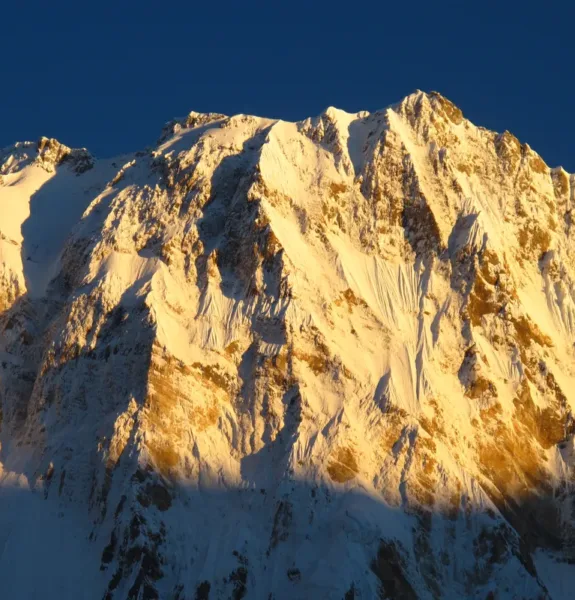
Our carefully planned itinerary takes you on a complete journey around the Annapurna Circuit mountain range, ending at the stunning Thorong La Pass (5,416m/17,769ft). During this amazing trek, you’ll pass through the beautiful Annapurna Conservation Area, where snowy mountains, misty valleys, and traditional villages create a truly unforgettable view of Nepal’s natural beauty.
You’ll be pushing past 5,000 meters, and it’s no joke. But the reward? Walking through ancient Gurung villages that still live by their old ways. Then there’s the Kali Gandaki Gorge – the deepest in the world with Annapurna I towering on one side and Dhaulagiri on the other. These mountains aren’t just tall, they’re massive. It’s wild, it’s raw, and it’s something you’ll carry with you forever.
Annapurna Circuit Trek Route
Annapurna Circuit Trekking Trail is one of the most versatile routes you will come across during your holiday trips to Nepal. This traditional route runs around the entire range of the Annapurna Massif and gives you access to all sorts of landscapes ranging from green valleys to dense alpine woods and dry mountain desert terrain. The varying landscape, culture, and elevation levels make this route an ultimate Himalayan adventure.
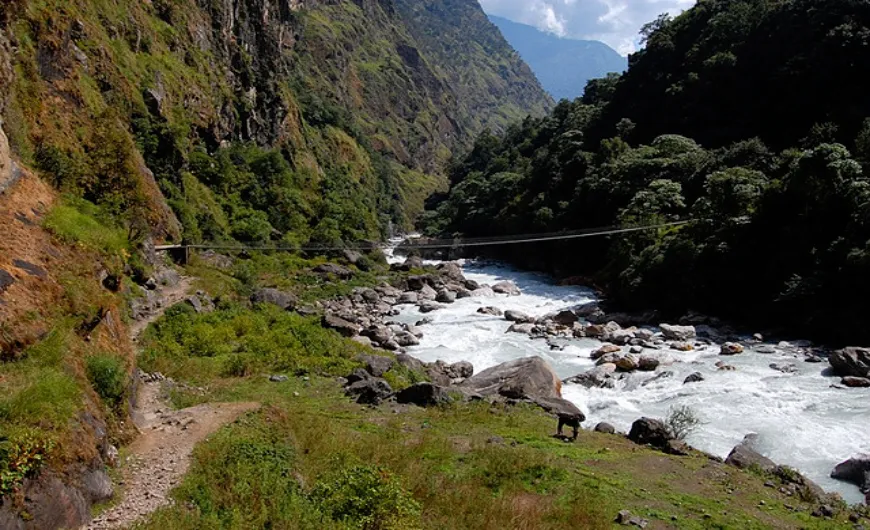
Traditionally, this tour commences by driving from Kathmandu to either Jagat or Dharapani. After that, the Annapurna Circuit Trekking route begins to traverse along the valley formed by the Marsyangdi River. The treks pass through several villages such as Chame, Pisang, and Manang. The latter is an excellent location to take acclimatization for a couple of days before proceeding further up. As you travel, the trails begin showing the mighty peaks like Annapurna II, III, and Gangapurna.
After Manang, the spectacular scenery of Annapurna Circuit trek kicks off, especially when you are heading for Yak Kharka and Thorong Phedi. And without a doubt, the most difficult and simultaneously the most fulfilling part of the whole route is crossing Thorong La Pass at the height of 5,416 meters. This is the peak point of Annapurna trek and your personal accomplishment! Once on the other side of the pass, you will experience the desert-like, windy, moon-like landscape of the Mustang area.
The downhill will lead you to the holy place Muktinath, after which you will go further to Jomsom and Tatopani to take advantage of the natural hot springs. And then you will finally arrive at Ghorepani and Poon Hill in preparation for the last leg of the route, ending near Pokhara. This trekking schedule of Annapurna Circuit is simply an amazing combination of adventure, cultural elements, and breathtaking mountains.
Annapurna Circuit Trek – Thorong La Pass Challenge:
The hardest part of the Circuit is the climb from Thorong Phedi up to Thorong La Pass at 5,416 meters. It’s a tough, steep 45-minut e climb at high altitude that’ll push you physically. But when you reach the top, the views make it all worth it.
The Annapurna Circuit gives you some of the best Himalayan sights you’ll find places like the Annapurna Conservation Area, Manang, Pisang, Muktinath, and Jomsom. You’ll see natural hot springs, Tibetan culture, colorful prayer flags, and meet friendly Gurung villagers along the way.
Get ready for a trek that’s as tough as it is beautiful. With good fitness and grit, the Annapurna Circuit will give you an experience you won’t forget.
Highlights of Annapurna Circuit Trek
- Thorong La Pass – The trek’s highest point offering spectacular mountain views
- Diverse landscapes – From subtropical forests to alpine deserts and glacial valleys
- Cultural immersion – Traditional Gurung, Magar, and Tibetan villages
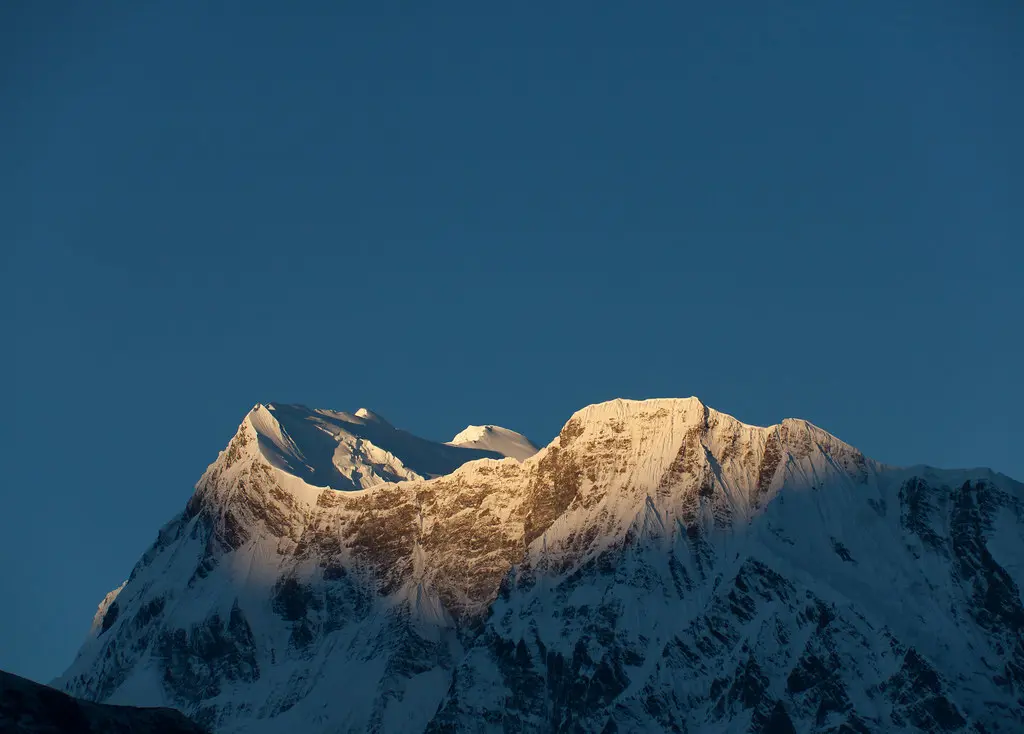
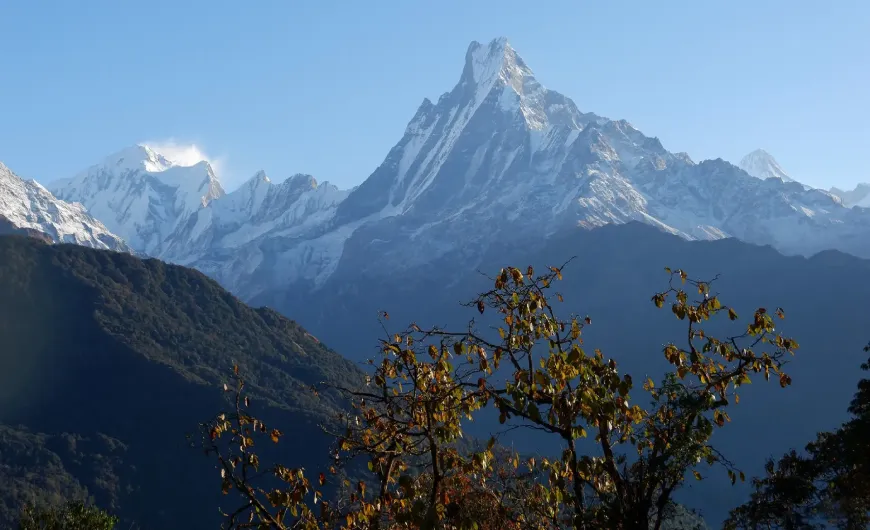
- Mountain views – Close-up vistas of Annapurna I, II, III, IV, Dhaulagiri, Machapuchare, and Manaslu
- Muktinath Temple – Sacred pilgrimage site for both Hindus and Buddhists
- Manang village – Perfect acclimatization stop with stunning mountain backdrop
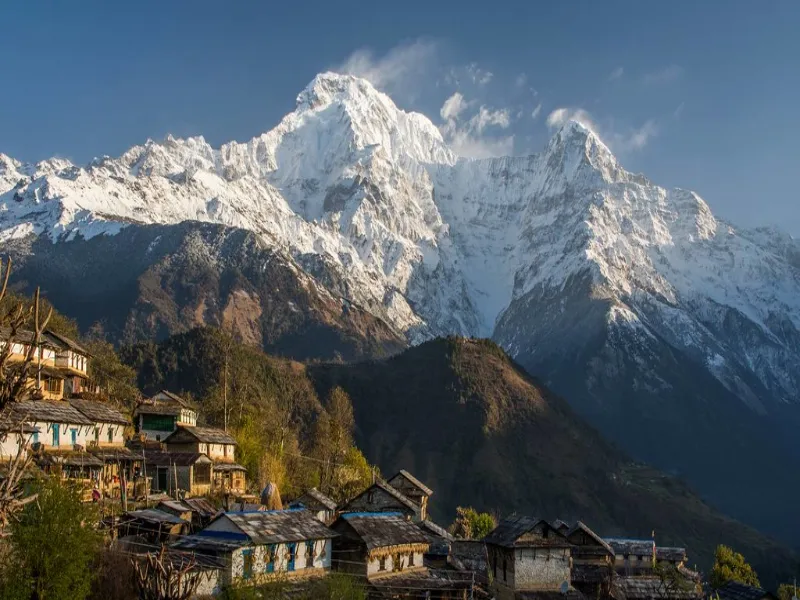
Photo Gallery & Video Gallery
Annapurna Circuit Trek - Distance, Duration, and Altitude
| Trekking Route | Distance (Kilometers) | Duration (Hours) | Altitude (Meters) |
|---|---|---|---|
| Jagat to Dharapani | 10 KM | 5 to 6 hours | 1860 m. |
| Dharapani to Chame | 13 KM | 6 to 7 hours | 2670 m. |
| Chame to Pisang | 13 KM | 5 to 6 hours | 3300 m. |
| Pisang to Manang | 17.2 KM | 6 to 7 hours | 3519 m. |
| Manang to Yak Kharka | 10 KM | 4 to 5 hours | 4018 m. |
| Yak Kharka to Thorong Phedi | 6.5 KM | 2.5 hours | 4450 m. |
| Thorong Phedi to Muktinath via Thorong La Pass | 15.1 KM | 8.5 hours | 5416 m. |
| Muktinath to Jomsom via Kagbeni | 12 KM | 4 to 5 hours | 3802 m. |
Itinerary of Annapurna Circuit Trek
Day 01: Arrival in Kathmandu
Upon arrival at Kathmandu’s Tribhuvan International Airport, you’ll be transferred to your hotel. You can explore the vibrant street of Thamel.
Rest and prepare for your trek.

Max. Altitude: 1334m./4,377ft. (Kathmandu)

Meal: Breakfast, Lunch, Dinner

Accommodation: 3 Star Hotel
Day 02: Sightseeing and Trek Preparation in Kathmandu
Visit some of Kathmandu’s UNESCO World Heritage Sites, including Pashupatinath Temple, Boudhanath Stupa, and Kathmandu Durbar Square. In the evening, attend a trek briefing and check gear, ensuring everything is ready and prepared for your journey into the Annapurna region.
Max. Altitude: 1324m./4,344ft. (Kathmandu)
Meal: Breakfast, Lunch, Dinner
Accommodation: 3 Star hotel
Day 03: Drive from Kathmandu to Jagat (1140m)
Today you will officially begin your trekking journey from Kathmandu to Jagat in a scenic drive through hills, terraced farmlands, and open landscapes to reach Jagat, the gate way to Annapurna region. Along the drive you can see traditional villages, local villages and shrines.

Activity: 8-10 hours
Max. Altitude: 1140m./3,740ft. (Jagat)
Meal: Breakfast, Lunch, Dinner
Accommodation: Standard Teahouse
Day 04: Trek from Jagat to Dharapani
Begin your trek from Jagat toward Dharapani through lush forests, terraced fields and small villages. The trail ascends gradually, offering glimpse of snow-capped mountains. After reaching Dharapani you will stay there for a warm meal and a night to spend.
Activity: 5-6 hours
Max. Altitude: 1860m./6,102ft. (Dharapani)
Meal: Breakfast, Lunch, Dinner
Accommodation: Teahouse
Day 05: Trek from Dharapani to Chame
You will pass through beautiful waterfalls and alpine scenery on your way to Chame, the district headquarters of Manang. The scenery opens to wide valleys and terraced farmlands with snow capped mountains in the distance. You will stay at Chame overnight for a warm meal to rest your body for the next day’s trek.
Activity: 4-5 hours
Max. Altitude: 2610m./8,563ft. (Chame)
Meal: Breakfast, Lunch, Dinner
Accommodation: Teahouse
Day 06: Trek from Chame to Pisang
Follow the trail alongside the Marsyangdi River and walk through pine forests. Upon reaching Pisang, it provides stunning views of Annapurna II and IV from its hilltop location. You can even see colorful prayer flags and monasteries and experience the traditional mountain life.
Activity: 5-6 hours
Max. Altitude: 3115m./10,220ft. (Pisang)
Meal: Breakfast, Lunch, Dinner
Accommodation: Teahouse
Day 07: Trek from Pisang to Manang
The upper Manang region is a high altitude desert place, where the rainfall is much less, leading to a much drier and desert-like landscape. During the hike in Upper Pisang via Ghyaru, you can see some of the most panoramic mountain views. After reaching Manang, a major acclimatization stop is necessary.
Activity: 5-6 hours
Max. Altitude: 3540m./11,614ft. (Manang)
Meal: Breakfast, Lunch, Dinner
Accommodation: Teahouse
Day 08: Acclimatization Day in Manang
This day is a rest day to allow your body to adjust to the high altitude. During this acclimatization stop you can explore the village, visit monasteries, and enjoy the stunning view of Gangapurna, Annapurna III, and Tilicho Peak. This is the opportunity to enjoy the Himalayan views.
Max. Altitude: 3540m./11,614ft. (Manang)
Meal: Breakfast, Lunch, Dinner
Accommodation: Teahouse
Day 09: Trek from Manang to Yak Kharka
A gradual climb through alpine meadows and yak pastures brings you to Yak Kharka. During the trek, the trail offers stunning view of the Chulu peaks and the Annapurna range. You can see small settlements with a glimpse of terraced farming and traditional lifestyle, where you stay overnight.
Activity: 3-4 hours
Max. Altitude: 4050m./13,287ft. (Yak Kharka)
Meal: Breakfast, Lunch, Dinner
Accommodation: Teahouse
Day 10: Trek to Thorong Phedi
It is a shorter trek but challenging hike that brings you to the base of Thorong La Pass. During this trek, the air becomes thinner, and the terrain is mostly rocky. Here you will rest early for the next day’s ascent.
Activity: 2-3 hours
Max. Altitude: 4450m./14,600ft. (Thorong Phedi)
Meal: Breakfast, Lunch, Dinner
Accommodation: Teahouse
Day 11: Cross Thorong La Pass (5,416m) and Trek to Muktinath (3,802m)
You will begin your trek in the early morning that takes you across legendary Thorong La Pass, one of the highest trekking passes in the world. It is a tough yet rewarding day. After reaching the Throlang la Pass, you will descend toward the sacred temple town of Muktinath and enjoy the unique culture and traditions.
Activity: 8.5 hours
Max. Altitude: 5416m./17,769ft. (Thorong la Pass)
Meal: Breakfast, Lunch, Dinner
Accommodation: Teahouse
Day 12: Trek to Jomsom(2,743m) via Kagbeni(2,804m)
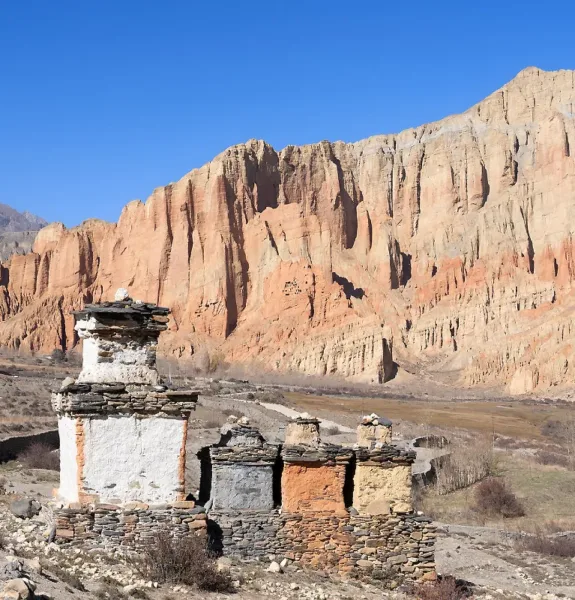
Descend through the arid Mustang region, passing through the ancient village of Kagbeni. With deep valleys, desert like terrain a small villages, the landscape drastically changes before reaching the windy town of Jomsom.
Activity: 7-8 hours
Max. Altitude: 2804m./9,199ft. (Kagbeni)
Meal: Breakfast, Lunch, Dinner
Accommodation: Teahouse
Day 13: Flight or Drive from Jomsom to Pokhara
Get back to Pokhara either by a scenic drive in hilly highways through Dhikur Pokhari, Beni settlements and Tatopani. You can also take a direct flight from Jomsom. As well you can fly to Kathmandu the same day if you want, but we recommend you to stay a night in Pokhara for the beautiful Lake side experience in the Queen of City.
Activity: flight: 35 min, drive: approx. 4 hours
Max. Altitude: 820m./2,690ft. (Pokhara)
Meal: Breakfast, Lunch, Dinner
Accommodation: Standard Hotel
Day 14: Drive or Fly Back to Kathmandu
Return to Kathmandu by road or by air. Celebrate the successful completion of your trek in the evening.
Activity: Flight: 30 min, Drive: 6-7 hours
Max. Altitude: 1324m./4,344ft. (Kathmandu)
Meal: Breakfast, Lunch, Dinner
Accommodation: 3 star Hotel
Day 15: Departure
After breakfast, you will be transferred to the airport by our representative according to your scheduled flight time. Enjoy your final moments in the land of Nepal as you bid farewell with cherished memories of the Annapurna region. Have a safe flight!
Activity: 35 minutes
Meal: Breakfast
Includes/Excludes
What is included?
- Permits and Fees: All necessary permits for the Annapurna Circuit Trek, including the Annapurna Conservation Area Permit (ACAP) and the TIMS (Trekkers’ Information Management System) card.
- Accommodation: Accommodation during the trek, usually in teahouses or lodges. This typically includes accommodations in Kathmandu and Pokhara before and after the trek in 3 star hotel on BB plan. (twin sharing basis)
- Meals: Most packages will include three meals a day (breakfast, lunch, and dinner) during the trek.also includes two times hot beverage (in breakfast and lunch) and seasonal fruits after dinner.
- Transportation: Ground transportation from Kathmandu to the trailhead (usually Besisahar) and from the end point of the trek back to Kathmandu.
- Guide and Porters: Services of an experienced English-speaking trekking guide and porters to carry luggage. This includes their salary, insurance, equipment, food, and accommodation.
- First Aid Kit: A basic first aid kit.
- Trekking Map: A map of the trekking route.
- Equipment: Duffle Bag, Sleeping Bag (if necessary)
- Pick up drop-off : airport pick up and drop-off by private vehicle.
What is not included?
- International Flights: International airfare to and from Nepal is not included.
- Travel Insurance: Travel insurance that covers emergency rescue and evacuation is not included, and you’ll be expected to have your own.
- Personal Expenses: Expenses for extra meals, drinks, snacks, charging devices, hot showers, Wi-Fi, and other personal costs are not included.
- Nepal Visa Fees: Entry visa fees for Nepal.
- Additional Accommodation and Meals: If you choose to extend your stay in Nepal, the cost of additional accommodation and meals will not be included.
- Rescue and Evacuation: Any costs related to emergency evacuation or rescues are not covered.
- Trekking Gear: Personal trekking equipment, such as hiking boots, down jackets, trekking poles, and other gear are not included.
- Tips: Tips for guides and porters are not included and are left to your discretion.
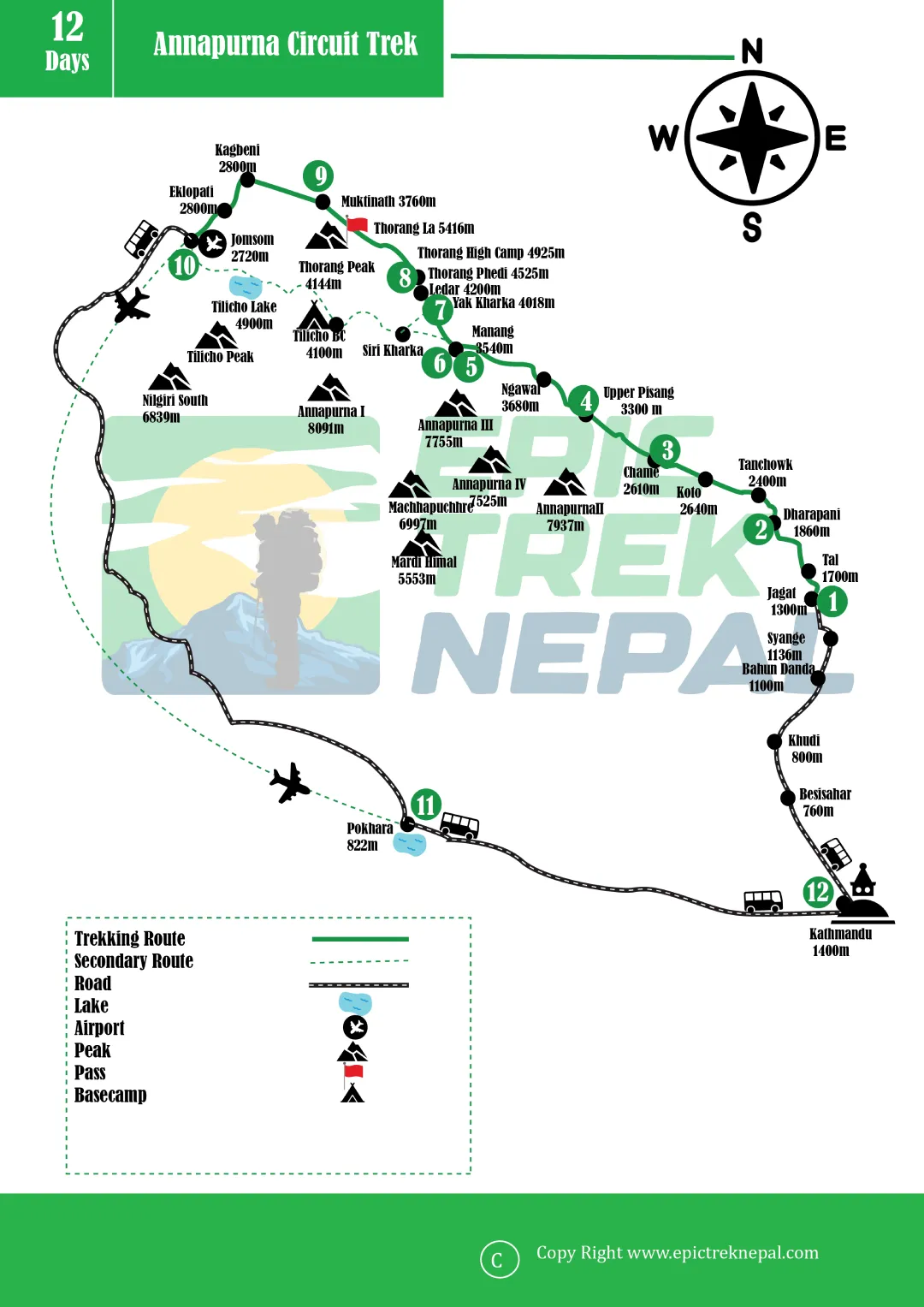
Trip Map of Annapurna Circuit Trek
Trip Information
Difficult Level of Annapurna Circuit Trek
The Annapurna Circuit is a tough trekking that requires quite a lot of fitness and willpower. Though one does not require special climbing gear and skills, such as harnesses and ropes, it remains physically and psychologically demanding due to long walking days and high altitudes. On average, trekkers walk for 5–7 hours a day along different terrains, ranging from stone staircases and forests to very rocky surfaces.
Undoubtedly, the most significant difficulty that arises during the Annapurna Circuit Trek is connected with the height above sea level. It reaches its peak altitude at the pass of Thorong La, where one climbs to 5,416 meters above sea level. With increasing altitude, oxygen concentration becomes lower, which complicates breathing and slows down the walking speed. Therefore, one must take necessary breaks during the trek to adapt to high altitude in Manang.
As if the above was not enough, the Annapurna Circuit view trek includes several very steep ascends followed by very long descends after. Weather-wise, things could also get tricky since there are sudden changes of weather conditions, and it gets really cold when you hit the higher altitudes. These elements definitely contribute to making the trek challenging.
However, despite the many challenges of the trip, the Annapurna Circuit trekking route is possible for almost anyone provided that one prepares for it thoroughly. Regular workouts, stamina building exercises and the ability to walk slowly but surely will greatly help here. When everything is prepared and the right mind set is achieved, this tour becomes very enjoyable and memorable indeed.
Cultural Festivals along the Trail
There are quite a number of cultures that one could discover along the Annapurna Circuit trek. While the peaks are beautiful in their own way, it is interesting that these mountains also hold various cultures, communities and customs that should not be neglected.
If one takes the trip in the region of Manang or Mustang in the particular season, then it will become possible to join a festival such as the Lhosar, which is the celebration of Tibetan New Year. Such events are full of dances, music, singing and participation of the whole community members in different rituals.
Another interesting experience can happen for those who take the Annapurna Circuit trek from the lowlands. In this area, travelers can enjoy such famous Hindu festivals as the Dashain and Tihar. These celebrations make the life of locals more colorful and joyful. The hospitality of the villagers is impressive, as the visitors usually try a lot of local dishes and participate in all rituals and festivities.
Preparation for Annapurna Circuit Trek
A good preparation is the key to having an enjoyable experience on the Annapurna Circuit trek as well as being safe and healthy throughout the entire journey. This particular trek offers a lot of different terrains, and sometimes extremely high altitudes – that is why it is important to prepare properly before taking such a serious journey.
To start with, you need to build up your endurance. At the very least, you should have enough energy and physical capabilities to walk about 5–7 hours each day. The focus here should be on cardiovascular training – hiking, jogging, riding a bike, etc. It would be good if you also added stair climbing and leg exercises into your workout routine.
Acclimatization cannot be overlooked when thinking about Annapurna Circuit trekking. Make sure that during your trip planning you include several acclimatization rest days, particularly in Manang. All you have to do here is walk slow and drink lots of water. This will help your body adapt to the thin atmosphere and reduce altitude sickness risks greatly.
The importance of having proper equipment cannot be understated. In case you do not have an experienced guide by your side, make sure to pack appropriate clothes, sturdy boots that will be comfortable from the very beginning, sleeping bag, etc. Weather conditions here can change unexpectedly, so you always need to have what you require on you at all times.
Finally, be ready mentally as well because there might be days when you are going to feel tired. This is natural since some days will pass high up in the mountains. Try not to lose your enthusiasm and keep on moving at your own pace. Remember that it is important to look around sometimes and actually appreciate your surroundings.
Mobile network, internet & charging facilities
When it comes to the mobile network, internet access, and charging stations for your battery during the Annapurna Circuit trek, you will find all of them but don’t set your sights too high. The network is usually not reliable as you may expect it to be when you are at home, and the quality of the network goes down the more height you gain.
The lowlands of the Annapurna Circuit trek feature a reliable network with operators such as NTC or Ncell where you will easily manage to make calls and even use some internet. However, as you start ascending into the higher places, the quality of the network is going to drop. When you reach the regions of Manang and above, you will notice that the connection will not be available at times.
While you will come across free Wi-Fi in most of the teahouses on the Annapurna Circuit view trek, expect to pay additional money for the code. It should be noted that the connection is very slow and won’t be able to perform heavy operations such as video conferencing or downloading any sizable content. As a result, it will only be suitable for sending a quick WhatsApp message or a status report to your friends and family.
In terms of charging your phone or camera batteries, it’s possible to find these services throughout your journey. While in the lower villages, you may be able to find a charger directly in your room, you will need to use it in the dining room in higher locations. Moreover, you will need to pay a little extra for this service since many of them are powered by solar panels, meaning that the process might be somewhat limited on days when the weather is cloudy.
Language and Communication
Language and communication on the Annapurna Circuit trekking are quite easy and comfortable. The route being very popular, many people understand English, starting from a basic level up to fluent English, especially guides, porters, and teahouse owners. That is why daily communication while trekking through the Annapurna Circuit will be rather simple and convenient for travelers.
In lowland areas, the use of English language is universal for almost all hostels and small stores. Climbing further to Manang and other upper regions, English is understood by the local population but may vary depending on the remoteness of settlements. Nevertheless, there will be no problems in understanding and being understood.
Probably the most interesting thing about Annapurna Circuit view trekking is visiting various communities full of culture and history. In fact, expect a lot of local languages including Nepali, Gurung, and even Tibetans influences at times. Frankly speaking, knowing a few basic words of Nepali such as “Namaste” (“Hello”) or “Dhanyabad” (“Thank you”) will do wonders with locals who always seem to appreciate efforts made by travelers to communicate.
You may use any applications to communicate as long as you get some Wi-Fi access points, yet I suggest being careful about it since internet connection may turn out unpredictable at times. Having a local guide makes your journey a lot easier not only regarding translation but obtaining information that may not be available without a guide’s help. Language barriers are not really a problem on Annapurna Circuit Trek. A bit of English knowledge coupled with a nice attitude and you’ll easily connect with locals during the trip.
Don’t on the Annapurna Circuit Trek
Do not increase your speed. Some people make an effort to walk faster from the start but this can lead to altitude sickness. Follow your itinerary and take time to acclimatize, particularly at Manang.
Do not ignore the first signs of altitude sickness. Symptoms like headache, nausea, and feeling dizzy are no laughing matter. When things start to worsen, do not ascend further but go down immediately.
Do not depend solely on technology. The mobile and internet connection is not available in some areas during the Annapurna Circuit view trek. Carry a map or hike with a guide for safety measures.
Neither should you pack too much nor too little. Excess baggage makes for tough trekking, while lack of basic necessities will lead to discomfort. Make sure that you pack well, keeping your luggage neither too heavy nor too empty.
Never disrespect the local culture or environment. Try to dress decently, always ask permission before photographing, and do not litter. Show respect for both the mountainous area and its locals.
Last but not least, never start trekking unprepared. Poor physical shape and lack of preparation may make an amazing expedition quite a painful one. Once you’ve passed Manang and are going even higher, that network becomes unreliable or in truth, there’s no guarantee it’ll work at all in some of the more hidden spots.
Health and Safety on Annapurna Circuit Trek
Without a doubt, health and safety should always be prioritized during the Annapurna Circuit trek. One must be very careful of acute mountain sickness when reaching closer to the altitude at which the Thorong La pass lies. My most important recommendation would be to walk slowly, drink lots and lots of water, and never neglect the acclimatization days on the Annapurna Circuit trekking itinerary. There’s a reason why certain places such as Manang exist. Your body requires time to adjust to the lower oxygen concentration in the atmosphere.
Your body needs to be listened to. When experiencing a persistent headache, nausea, dizziness, or other symptoms related to altitude sickness, it’s essential to take a break and rest before resuming your journey. However, when these symptoms do not fade even after resting for some time, then descending to a lower altitude is inevitable. In addition, it wouldn’t hurt to pack a small first aid kit along with any necessary personal medications. Lastly, travel insurance that covers high-altitude trekking should be purchased.
The weather up in the mountains is completely unpredictable as well, and can turn on a dime. Bring lots of warm clothing, rain gear that works, and wear footwear that has been properly broken in. Traveling with a guide or a minimum of a few people is also highly recommended, particularly on the remote parts of the Annapurna Circuit view trek.
Trek Extension on Annapurna Circuit Trek
If you don’t feel that the main route is adequate, there are some excellent side trips to add to your Annapurna Circuit trek. One of the most commonly taken is the trek up to Ice Lake from Manang. In addition to the difficult climb, the views are just spectacular and there are excellent spots to acclimatize for the pass.
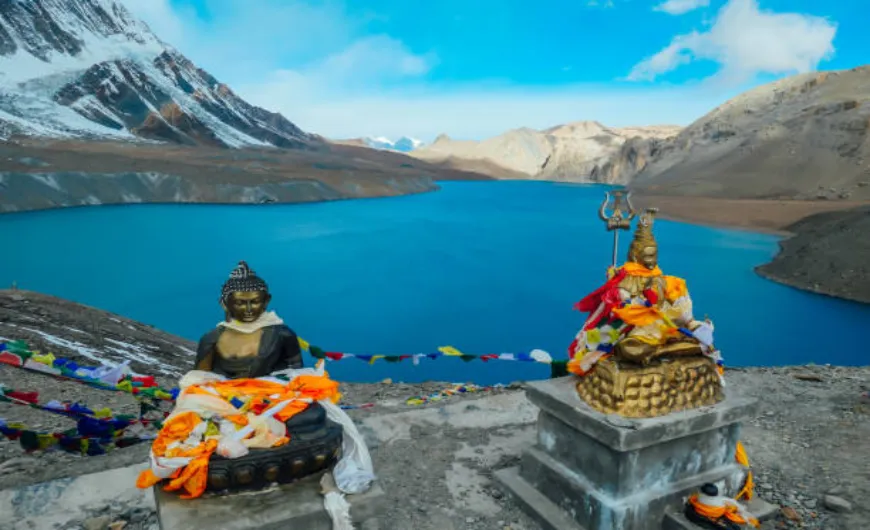
Another major destination is Tilicho Lake, which is one of the highest lakes in the world. Although it takes several extra days to reach, the natural beauty is beyond amazing and is worth the effort if you are fit enough to make the detour.
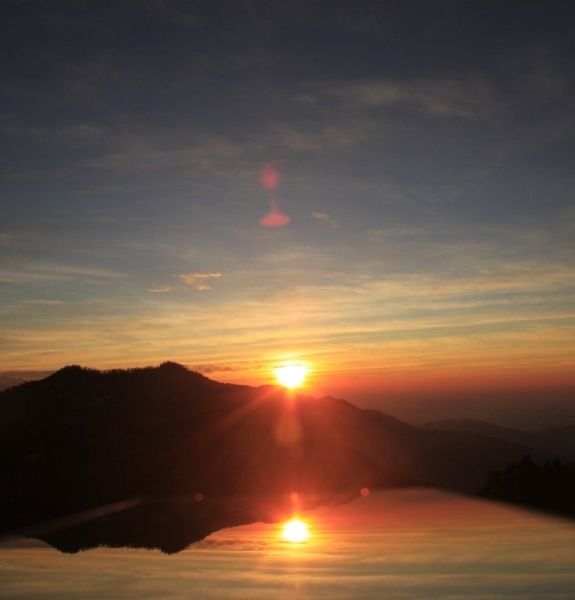
After crossing Thorong La Pass, you can extend your trek into the Mustang region, spending additional time in Muktinath and Jomsom to learn more about the local culture and desert-like landscape. Some trekkers may also go on to reach Ghorepani and Poon Hill for that iconic sunrise, which would provide a great way to complete their journey.
Communication for Annapurna Circuit Trek:
Staying connected with your family, friends and loved-ones during your Trek is crucial. And we’ll provide various options to ensure your communication throughout the journey.
Guides’ Local Cell Phones:
Guides have carried the local cell phones, you can ask theirs phone to communication on the trail. You’ll have a reliable means of communication, even in remote areas.
Local SIM Cards:
If you bring your cell phone, obtaining a local SIM card is a convenient option. Our guides or representatives can assist you in acquiring a local SIM card upon your arrival, making it easier for you to stay connected with family and friends throughout the trek.
Wi-Fi at Teahouses:
For those who prefer Wi-Fi connectivity, most teahouses along the Annapurna Circuit route offer this service at an additional cost. Take advantage of this option to share your trekking experiences, update social media, or simply stay connected with the outside world than the mountain’s landscape.
Satellite Telephones for Emergencies:
Your safety is our priority. In case of emergencies, we utilize satellite telephones to establish communication. This is a reliable way of reaching out for assistance, providing an additional layer of security during your trek.
Stay connected, share your Annapurna Circuit adventure, and have peace of mind with our comprehensive communication options tailored to enhance your trekking experience.
Permits for Annapurna Circuit Trek:
The Annapurna Circuit Trek requires essential permits – the Annapurna Conservation Area Permit (ACAP) and the Trekkers’ Information Management System (TIMS) card. These permits are not just regulatory but also vital for sustainable trekking in Nepal.

ACAP – Unlocking the Annapurna Conservation Area
What Is It: ACAP is a must-have permit for the Annapurna Conservation Area, integral to your trek.
Purpose:
Legal access and contributing to ecosystem sustainability.
Why You Need It:
Funds from ACAP aid conservation, community development, and trail maintenance, ensuring a responsible and eco-friendly trekking adventure.
TIMS Card – Ensuring Safety and Support:
What Is It:
A mandatory card for all Nepal trekkers, including the Annapurna Base Camp.
Purpose:
Enhancing safety, emergency preparedness, and supporting local authorities.
Why You Need It:
Crucial for quick location in emergencies, contributing to a secure trekking environment, and supporting Nepal’s sustainable trekking routes.
Both of these permit can be obtained through us “Epic Trek Nepal“. Prepare responsibly, support sustainability, and enjoy a safe Annapurna Circuit Trek with the necessary ACAP and TIMS permits.
Insurance for Annapurna Circuit Trek:
The Annapurna Circuit Trek is full of adventure and unforgettable moments but your safety is what matters most. That’s why having good travel insurance isn’t just a suggestion, it’s a must.
Annapurna Circuit Trek is the most preferable destination including all adventure, culture and nature within it. With that we put your safety as our priority. That’s why having the right travel insurance is essential.
- High Altitude Coverage: Make sure if your insurance covers trekking above 5,000 meters. Some sections of the trail, like Thorong La Pass, reach high elevations where altitude-related issues can occur.
- Helicopter Evacuation: In case of serious illness or injury, helicopter rescue might be the only option. Your insurance must include emergency evacuation coverage.
- Trip Cancellations or Delays: Weather changes, illness, or personal emergencies can affect your travel plans. Good insurance helps recover costs if your trip gets delayed or canceled.
- Lost or Damaged Gear: Your backpack, gear, or personal items are important on the trail. Insurance that covers loss or damage will give you peace of mind as you trek.
Before hitting the trail, double-check your insurance policy. Make sure it covers everything you need – and keep a copy with you during the trek. It’s one small step that helps keep the whole adventure safe and worry-free.
Frequently Asked Questions
The trek is 160–230 km long, depending on the route, and usually takes 12–18 days to complete.
You need the Annapurna Conservation Area Permit (ACAP) – NPR 3,000 (~USD 25) and the TIMS Card – NPR 2,000 (~USD 15–20).
Epic Trek Nepal pricing:
- Solo Trekker: $950 per person
- 2-3 person: $930 per person
- 4-6 person: $900 per person
- Group over 7: $800 per person
Includes all permits, accommodation, meals, guide, porter, and ground transportation (no flights required).
Thorong La Pass at 5,416 meters (17,769 ft) is the highest point of the trek.
Spring (March–May) and Autumn (September–November) offer the best weather and clear mountain views.
Epic Trek Nepal pricing:
- Group over 7: $800 per person
- Group of (4-6): $900 per person
- Group of (2-3): $930 per person
- Solo Trekker: $950 per person
Includes permits, accommodation, meals, guide, porter, and transportation.
They are not mandatory but highly recommended for safety and navigation; guides cost USD 25–35/day, porters USD 20–25/day.
Teahouses along the route offer basic rooms with shared bathrooms, hot showers (paid), and simple meals like dal bhat, noodles, and pancakes.
It is moderate to difficult due to altitude and long walking days; proper acclimatization is essential.
Yes, ensure your policy covers trekking above 5,000 meters and includes helicopter evacuation.
ATMs are limited; carry enough Nepalese Rupees from Kathmandu or Pokhara before starting the trek.
Trip Reviews
US$ 930
Need Help? Talk to Expert
+977 9764792172