
Makalu Base Camp Trek
73 reviews in Tripadvisor

Trip Duration
18 Days
Destination
Nepal
Max. Altitude
5,300 m.
Trip Difficulty
Easy
Group Size
1-12
Transportation
Tourist Vehicle
Accommodation
Hotel/Teahouse
Activity
Trekking/Hiking
Meals
All inclusive
Start / End
Kathmandu
Region
Makalu-Barun
Best Season
Spring, AutumnUS$ 1870

Need Help? Talk to Expert
+977 9764792172Trip Overview
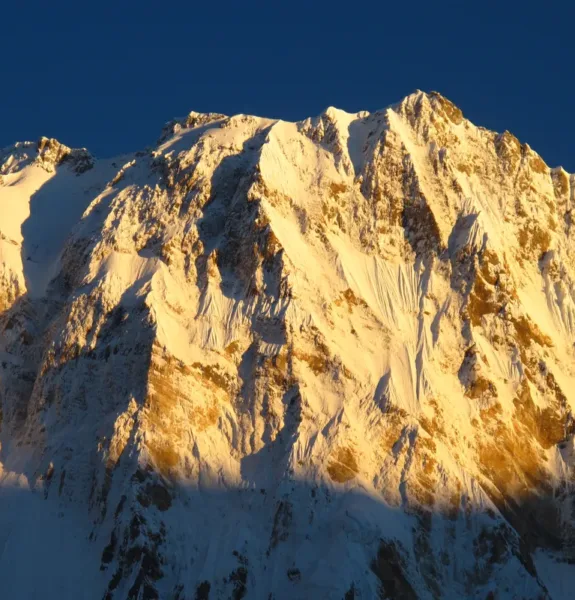
Recognized as the world’s 5th highest mountain in the world, Mt. Makalu is one of the extraordinary and less explored trekking trail of Nepal situated at 8,485m (27,838 feet). Makalu Base Camp Trek route reveals the panoramic views of majestic eight-thousanders, like, Everest (8,848.86 m), Makalu (8,463 m), Lhotse (8,516 m), Kanchenjunga (8,586 m), etc., as well as diverse landscapes ranging from lush forests to alpine meadows and rugged rocky terrains. The trekkers can get a unique opportunity to explore the remote village that maintains traditional ways of life.
This 18-day journey to Makalu Base View Camp Trek begins with a flight from Kathmandu to Tumlingtar, a small town in Sankhuwasabha district. And a short drive to Num, where your trek starts. Then the route gradually ascends through terraced farmland, subtropical forests, and past small settlements, giving trekkers a chance to experience the rich cultural heritage of the region, including Rai and Sherpa communities.
As you continue your trek towards Makalu Base Camp Trek, the adventurous activity increases, the valleys are narrow, there are glaciers on the way, and the stone trails are steeper. Trekkers need to go up around 5,000 meters at Makalu Base Camp Trek, which rewards them with a panoramic view of Makalu and other surrounding peaks.
Makalu Base Camp Trek Route
The trekking itinerary of the Makalu Base Camp View is perhaps one of the remotest trails in the whole of eastern Nepal. Your journey will begin by taking an air transfer to Tumlingtar and then travel by vehicle for a while from there to Num. From here, it is a descent to the Arun river and then a climb through dense jungles, Rai villages such as Seduwa and Tashigaon and other such locations.
Once you progress further, into Makalu Barun national park, you’ll come across landscapes which change. You’ll be passing through forests of rhododendrons and bamboo, as well as meadows. There will eventually be a point when your trek takes you on to places such as Khongma Danda, where passes you have to cross some high mountain passes. The view from above the hills and the , looking upon the majestic Himalayas, is absolutely breathtaking.
Further, the trail moves towards Dobate, Yangle Kharka, and Langmale Kharka. These sections of the trek are more isolated and quiet due to the fact that fewer numbers of trekkers use this trail than the popular trails. Gradually, the landscape will open out and you can experience the majestic scenery of the Mount Makalu and its surrounding peaks.
Ultimately, you will reach Makalu Base Camp Trek, which is a large alpine valley surrounded by mountains on all sides. It is one such area where you can just sit and take in the surroundings around you. Once you have had enough of the scenery, you will retrace your path back to Tumlingtar. The Makalu Base Camp View Trek is one such trek that combines culture, nature, and high mountain exploration.
Who this Trek is For
The Makalu Base Camp trek is accessible to everyone who is physically fit, mentally prepared to endure the grueling process, and genuinely desires to trek in such an exotic environment. No special technical skill is required here because this is no mountaineering adventure Hence, beginners can easily participate in this program too. However, one should be prepared to spend five to seven hours daily in trekking on uneven terrain.
As mentioned above, the trek is more suited for those who have prior experience in hiking or trekking. Those who have undertaken a number of trekking expeditions before will find it easy to cope with the situation since they have previous exposure to such an environment. On the other hand, those who undertake the journey for the very first time can also do so but with enough preparation and follow proper Makalu Base Camp Trekking Itinerary.
The people who typically love such an experience are those that are fond of adventures, love the nature of the area, and like photography. The main advantages of the view point trek of Makalu Base Camp View Trek include untouched landscapes and diverse wildlife. Additionally, one should bear in mind the fact that the crowd is rather small on this route, and it provides more genuine views of Nepal Makalu Base Camp View Trek for its visitors.
Please note that if you are expecting comfort and luxury, the route may be disappointing for you. Moreover, the facilities are very primitive and at times this route may appear absolutely deserted. For this reason, people who have any severe health problems or are not physically prepared for the route may find it rather challenging. With proper preparation and optimistic attitude towards this experience, the trekking can provide great enjoyment for many enthusiasts of the Himalayas.
Photo Gallery & Video Gallery
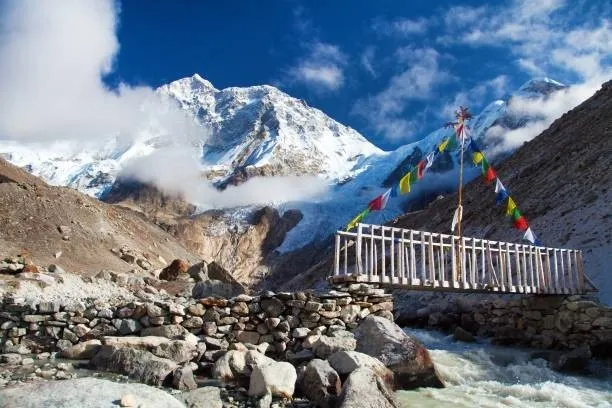
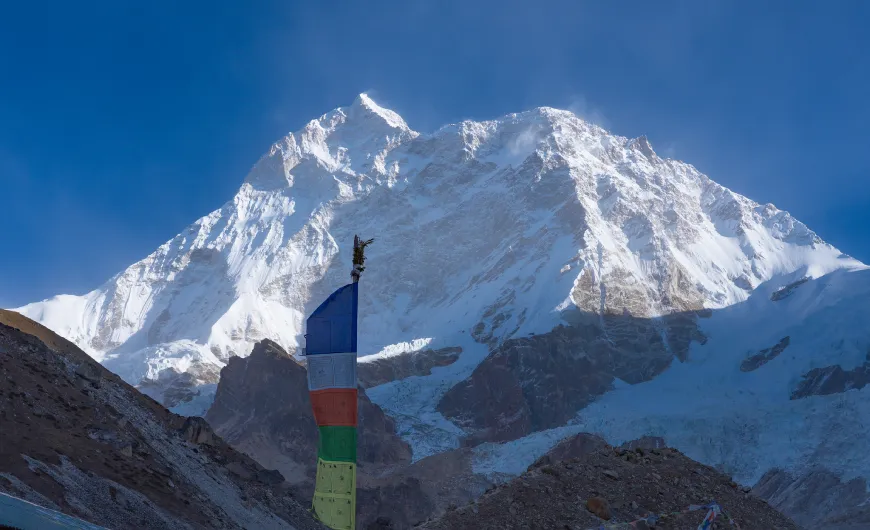
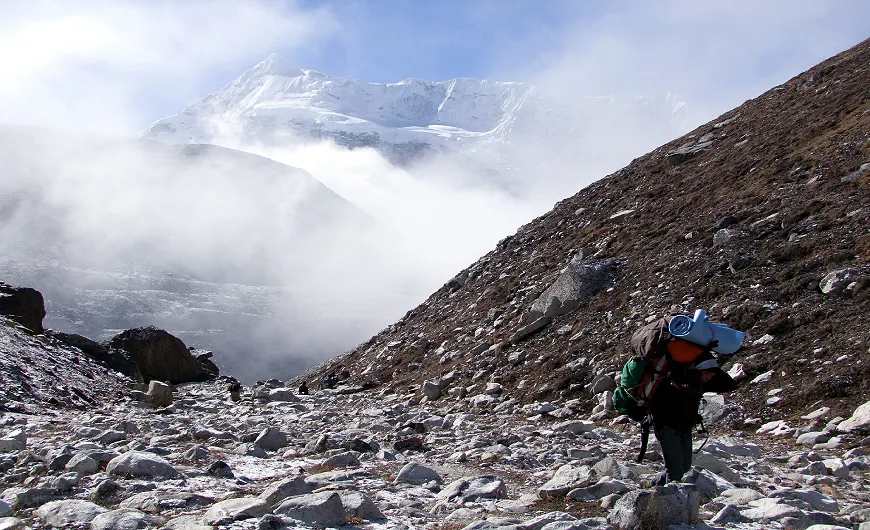
Makalu Base Camp Trek - Distance, Duration, and Altitude
| Trekking Route | Distance (Kilometers) | Duration (Hours) | Altitude (Meters) |
|---|---|---|---|
| Num → Seduwa | 8 KM | 5 to 6 hours | 1560 m. |
| Seduwa → Tashigaon | 7 KM | 5 to 6 hours | 2100 m. |
| Tashigaon → Khongma Danda | 7.2 KM | 7 hours | 3562 m. |
| Khongma Danda → Dobato (via Shipton La) | 7.6 KM | 6 to 8 hours | 4220 m. |
| Dobato → Yangle Kharka | 9.7 KM | 5 to 6 hours | 3800 m. |
| Yangle Kharka → Langmale Kharka | 10.5 KM | 5 hours | 4410 m. |
| Langmale Kharka → Makalu Base Camp | 8.7 KM | 5 to 6 hours | 4870 m. |
| Makalu Base Camp → Yangle Kharka | 19 KM | 7 hours | 3557 m. |
| Yangle Kharka → Dobato | 9.3 KM | 6 hours | 3610 m. |
| Dobato → Khongma Danda | 7.6 KM | 6 to 7 hours | 4220 m. |
| Khongma Danda → Seduwa (via Tashigaon) | 14.2 KM | 9 to 10 hours | 3562 m. |
| Seduwa → Num | 8 KM | 5 to 6 hours | 1560 m. |
Itinerary of Makalu Base Camp Trek
Day 01: Arrival in Kathmandu
Welcome to the Kathmandu! Upon your arrival, one of our representatives from Epic Trek Nepal will be waiting to greet you and escort you to your designated hotel for rest.
Once you’ve settled in the hotel, you can just relax and recharge, or venture out and check out Thamel district with its various trekkers’ stores, restaurants, cafes, and many other things you can only see in Nepal. Later in the evening, please join us at our office to get some information about the trek and have a trek briefing. During this, we will discuss the Makalu Base Camp trekking itinerary, check your equipment, and answer all of your questions.

Activity: 35-min drive

Max. Altitude: 1324m./4,344ft. (Kathmandu)

Accommodation: 3-star hotel
Day 02: Fly from Kathmandu to Tumlingtar (518m) and drive to Num (1560m)
This is when the trip actually starts. Our destination is Tumlingtar, from where we will be flying to Tumlingtar. But if you have a window seat, then you can enjoy the stunning view of the hills and Himalayan range from above. On arrival at the destination, we will board our jeeps, which will take us to Num. The route is full of rural countryside scenes, and we will pass small villages such as Khandbari.
Along the way, we will get to enjoy different landscapes such as terraces and houses. The journey is quite exciting because there is no monotony, as we change the view after a few kilometers. Num lies on a ridge above the valley of Arun River.
Activity: 1 hour 20 min flight 5 hour drive
Max. Altitude: 1560m./5,118ft. (Num )

Meal: Breakfast, Lunch, Dinner
Accommodation: Standard Teahouse
Day 03: Trek from Num to Seduwa
Finally, the time to put one’s boots to good use! Today will mark the beginning of the trek with a steep downhill stretch from Num to the Arun River. From there, you can enjoy a steady climb through bamboo forests and small villages. The hike itself is relatively peaceful, as it takes you past local residences, you might even hear a ‘Namaste’ from the villagers. As we approach Seduwa, there will be a mandatory checkpoint for the national park where you need to register your permit.
This marks your official entrance into the protected wildlife sanctuary known for its high biodiversity. Seduwa is a laid-back village where we will camp for our first night of the trek.
Activity: 4-5 hour
Max. Altitude: 1510m./4,954ft. (Seduwa)
Meal: Breakfast, Lunch, Dinner
Accommodation: Teahouse
Day 04: Trek from Seduwa to Tashi Gaun
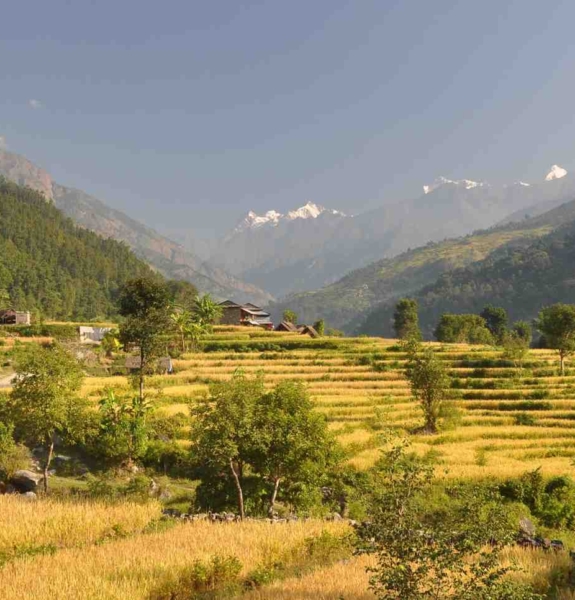
This day’s hike is somewhat inclined as you trek through cultivated land and forests. You will see these gorgeous terraces cultivated by locals who follow their traditional methods of farming.
As you ascend, the landscape begins transitioning into rhododendron and bamboo forests. When you come here during the spring season, the blossoms will make the landscape look so beautiful with color. You can see Mani walls and prayer flags on your trek. They will make you feel that spiritual element of the mountains.
Tashi Gaun is the last permanent village on the route. That is why it plays such an essential role in our itinerary for the trekking to Makalu Base Camp. Here you can relax, get some sleep, and prepare yourself for tomorrow’s hard days.
Activity: 4-5 hours
Max. Altitude: 2070m./6,791ft. (Tashi Gaun )
Meal: Breakfast, Lunch, Dinner
Accommodation: Teahouse
Day 05: Trek from Tashi Gaun to Khongma Danda
It is time to prepare yourselves because after leaving Tashi Gaun, the trail will get even more challenging, with you ascending steeply along some rocky trails and through the thick rhododendron forest.
The whole rhododendron forest in the spring season looks like a mass of colorful flowers and it is difficult to take your eyes off all these. However, we have to climb up and stop by at Dhara for a little rest before continuing our hike in the higher altitude area. As the altitude increases, breathing becomes harder. You can feel that temperature drops already when arriving at Khongma Danda.
Activity: 5-6
Max. Altitude: 3562m./11,686ft. (Khongma Danda)
Meal: Breakfast, Lunch, Dinner
Accommodation: Teahouse
Day 06: Acclimatization at Khongma Danda (Rest Day)
This day is entirely about being strategic. It is the acclimatization day that allows your body to get used to the altitude. A short climb towards the Khongma La will be done in order to increase the blood flow. The best strategy for adapting to the high altitude is to “climb high and sleep low.”
The route will provide breathtaking vistas of the mountains around. After reaching an ideal spot for observation, we shall stay there for a while before descending back to the Khongma Danda region. The remainder of the day is reserved for relaxation and hydration. This particular day plays a significant role in the successful completion of your trip.
Max. Altitude: 3562m./11,686ft. (Khongma Danda)
Meal: Breakfast, Lunch, Dinner
Accommodation: Teahouse
Day 07: Kongma Danda to Dobato
Undoubtedly, today will be one of the hardest days in the trekking journey; however, it would definitely pay off for you. Get ready to start your journey early since you will be encountering quite a few passes today. Your trek begins with an ascent to Khongma La and further continues in the heights while passing through Ghungru La, Shipton La, and, at last, reaching Keke La.
Each of these passes provides a great opportunity for viewing amazing views of such peaks as Makalu and Chamlang. It will take some effort on your legs since there are many ups and downs on the way; nonetheless, a quick recharge from a visit to Kalo Pokhari, a sacred mountain lake with many colorful prayer flags surrounding it, will help you. Having passed all these beautiful passes, you will descend and find yourselves at Dobato.
Activity: 5-6 hours
Max. Altitude: 4216m./13,832ft. (Shipton La)
Meal: Breakfast, Lunch, Dinner
Accommodation: Teahouse
Day 08: Trek from Dobato to Yangle Kharka
This journey involves trekking downhill and passing through pine and rhododendron forests that are absolutely beautiful. The trekking route is very quiet; all you hear is the flowing river and singing birds. Be careful during the descent because there are parts where the trail becomes a little steeper, and make sure you keep your eyes on the rocky ground.
As you descend further, you will notice that everything is turning green again. Your journey will involve following the Barun River through several small wooden bridges and occasional waterfalls. Yangle Kharka is situated in the vast valley, which is surrounded by huge mountains. This place provides a great opportunity for relaxing after the difficult climbs through the high mountain passes.
Activity: 5-6 hours
Max. Altitude: 3557m./11,670ft. (Yangle Kharka)
Meal: Breakfast, Lunch, Dinner
Accommodation: Teahouse
Day 09: Trek from Yangle Kharka to Langmale Kharka
Continue your walk along the route while passing a river and a tiny monastery. Admiring the stunning views of rocky cliffs at the other end, walk through the bush. The walk will be enjoyable and flat, as the mountain peak view will be visible. Pass through the grassland of Yak Kharka, Jhak Kharka, and Merek, and you will reach Lagmale Kharka. Watch the prayer flags swing in the air as we go by the Mani walls.
Activity: 4-5 hours
Max. Altitude: 4410m./14,469ft. (Langmale Kharka)
Meal: Breakfast, Lunch, Dinner
Accommodation: Teahouse
Day 10: Trek from Langmale Kharka to Makalu Base Camp
This is the real deal! The path ascends through the valley steadily, mainly passing through rocks and sand. As you proceed, things keep getting more thrilling. Crossing tiny streams and following the ancient glacial routes will get you closer to Mount Makalu, which keeps looming ahead with its awesome magnificence.
The climax of this entire journey awaits your arrival at Makalu Base Camp. Standing before the awe-inspiring mountains is an experience like no other. This is by far the best part of the trekking adventure.
Activity: 5-6 hours
Max. Altitude: 4870m./15,978ft. (Makalu Base Camp)
Meal: Breakfast, Lunch, Dinner
Accommodation: Teahouse
Day 11: Explore Makalu Base Camp (5100m)
This will be an entirely relaxation-focused day with plenty of time to observe your surroundings and acclimatize your body to the lower oxygen levels. We will typically trek higher than the campsite for a few hours to obtain the famous panoramic view.
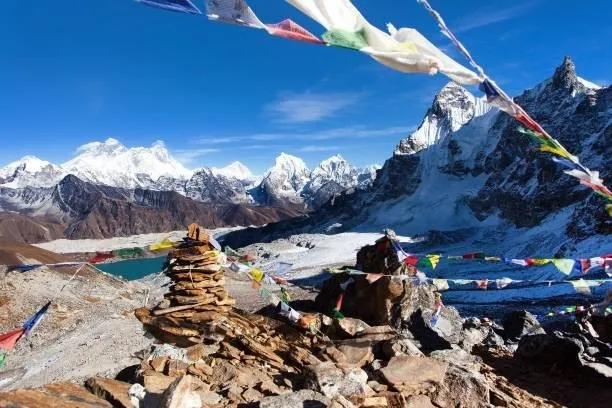
While the path to this viewpoint may be a little rugged and steep, the view from up top of Makalu, Peak 6, Peak 7, and the entirety of the Himalayas will be well worth the effort. Additionally, you could trek a little further to Barun Glacier and its many surrounding glacial lakes. This area feels very wild and untamed, adding an element of excitement to your experience.
Max. Altitude: 5300m./17,388ft. (Vantage Point)
Meal: Breakfast, Lunch, Dinner
Accommodation: Teahouse
Day 12: Trek from Makalu Base Camp to Yangle Kharkha
Now it is time to walk back down the same path. You will definitely find the downward trek much easier this time since you have lost a considerable amount of altitude! After walking through beautiful alpine terrain, you can look forward to seeing green once more as you descend further down into the valley. Though you are walking on the same path as before, this view provides yet another fresh perspective. When we arrive at Yangle Kharka, you only need to sit back and feel good about your accomplishment in trekking all the way to base camp!
Activity: 5-6 hours
Max. Altitude: 3557m./11,670ft. (Yangle Kharkha )
Meal: Breakfast, Lunch, Dinner
Accommodation: Teahouse
Day 13: Trek from Yangle Kharka to Dobato
The trek today takes us on a continuous uphill hike through the dense forest. This is quite enjoyable, with many birds singing around us and the soothing sound of the forest surrounding us. You will see those little bridges again and possibly come across some waterfalls that you did not see when going up.
Despite being in the dense forest, you can always catch a glimpse of the high mountains above through the foliage. Another stay at Dobato is planned. It is very serene there, and sleeping amid the cool forest breeze is highly rejuvenating.
Activity: 5-6 hours
Max. Altitude: 3610m./11,844ft. (Dobato )
Meal: Breakfast, Lunch, Dinner
Accommodation: Teahouse
Day 14: Trek from Dobato to Khongma Danda
Once again, we will have to cross the high passes for the last time, climbing once more up through Keke La, Shipton La, and Ghungru La. But even when returning, the scenery is truly amazing, especially the snowy peaks surrounding us.
Looking up to see the fluttering of prayer flags always gives me that extra lift. After crossing the last high pass, we make our way down to Khongma Danda. We’ll have another difficult hike today, but a very satisfying one too.
Activity: 5-6 hours
Max. Altitude: 3562m./11,686ft. (Khongma Danda )
Meal: Breakfast, Lunch, Dinner
Accommodation: Teahouse
Day 15: Trek from Khongma Danda to Seduwa
Today’s hike will be a gradual descent through the hilly landscape covered in greenery. The air will certainly feel warmer due to the drop in altitude. You will pass through the waterfall zone, small settlements, and the rice terrace zones again.
It is wonderful to experience such vibrant nature below after the mountainous area you were in before. Seduwa offers an opportunity for interaction with the local community and enjoying the relatively lower altitude.
Activity: 5-6 hours
Max. Altitude: 1510m./4,954ft. (Seduwa)
Meal: Breakfast, Lunch, Dinner
Accommodation: Teahouse
Day 16: Trek from Seduwa to Num and drive to Tumlingtar
This is your last day on foot! Today, we return to Num via a combination of both downward hikes and some enjoyable climbs in the Arun Valley. Once you get to Num, it will be all over for your trekking journey!
After reaching Num, you will travel by jeep to Tumlingtar, and that’s when you will end your trekking adventure. But not before having some time for yourself to unwind in a relaxing environment and enjoy the beautiful landscapes around you!
Activity: 4 hour walk and 5 hour drive
Max. Altitude: 518m./1,699ft. (Tumlingtar )
Meal: Breakfast, Lunch, Dinner
Accommodation: Lodge
Day 17: Fly back to Kathmandu
Today we will make our way to Kathmandu via flight. Don’t forget to gaze out through the plane’s windows and try and capture one last glimpse of the breathtaking Himalayan Range. Once on the ground, we will make sure that we get you safely checked into a comfortable hotel where you can freshen up before bed. If you have some remaining energy after your trip, you can walk around Kathmandu a little or even go shopping in Thamel.
Activity: 1 hour 20 min
Max. Altitude: 1324m./4,344ft. (Kathmandu)
Meal: Breakfast
Accommodation: 3-star hotel
Day 18: Departure
Your last day in Nepal. Bid farewell with cherished memories of the Himalayas in Nepal until next time. Our representative will escort you to the airport for your scheduled flight. Board your flight back home. Safe flight!
Activity: 35-min drive
Meal: Breakfast
Includes/Excludes
What is included?
- Permits and Fees: All necessary permits for the Langtang Valley Trek, including the Langtang National Park entry permit and the TIMS (Trekkers’ Information Management System) card.
- Accommodation: Accommodation throughout the trek, typically in teahouses or lodges. This generally includes accommodation in Kathmandu before and after the trek in 3 star hotel on BB plan. (twin sharing basis)
- Meals: Most packages will include three meals a day (breakfast, lunch, and dinner) during the trek.also includes two times hot beverage (in breakfast and lunch) and seasonal fruits after dinner.
- Transportation: Ground transportation from Kathmandu to Syabru Besi (or a similar starting point) and back.
- Guide and Porters: Services of an experienced English-speaking trekking guide and porters to carry luggage. This includes their salary, insurance, equipment, food, and accommodation.
- First Aid Kit: A basic first aid kit.
- Trekking Map: A map of the trekking route.
- Equipment: duffle bag, sleeping bag (if necessary)
- Domestic Flights
What is not included?
- International Flights: International airfare to and from Nepal is not included.
- Travel Insurance: Travel insurance that covers emergency rescue and evacuation is not included, and you’ll be expected to have your own.
- Personal Expenses: Expenses for extra meals, drinks, snacks, charging devices, hot showers, Wi-Fi, and other personal costs are not included.
- Nepal Visa Fees: Entry visa fees for Nepal.
- Additional Accommodation and Meals: If you choose to extend your stay in Nepal, the cost of additional accommodation and meals will not be included.
- Rescue and Evacuation: Any costs related to emergency evacuation or rescues are not covered.
- Trekking Gear: Personal trekking equipment, such as hiking boots, down jackets, trekking poles, and other gear are not included.
- Tips: Tips for guides and porters are not included and are left to your discretion.
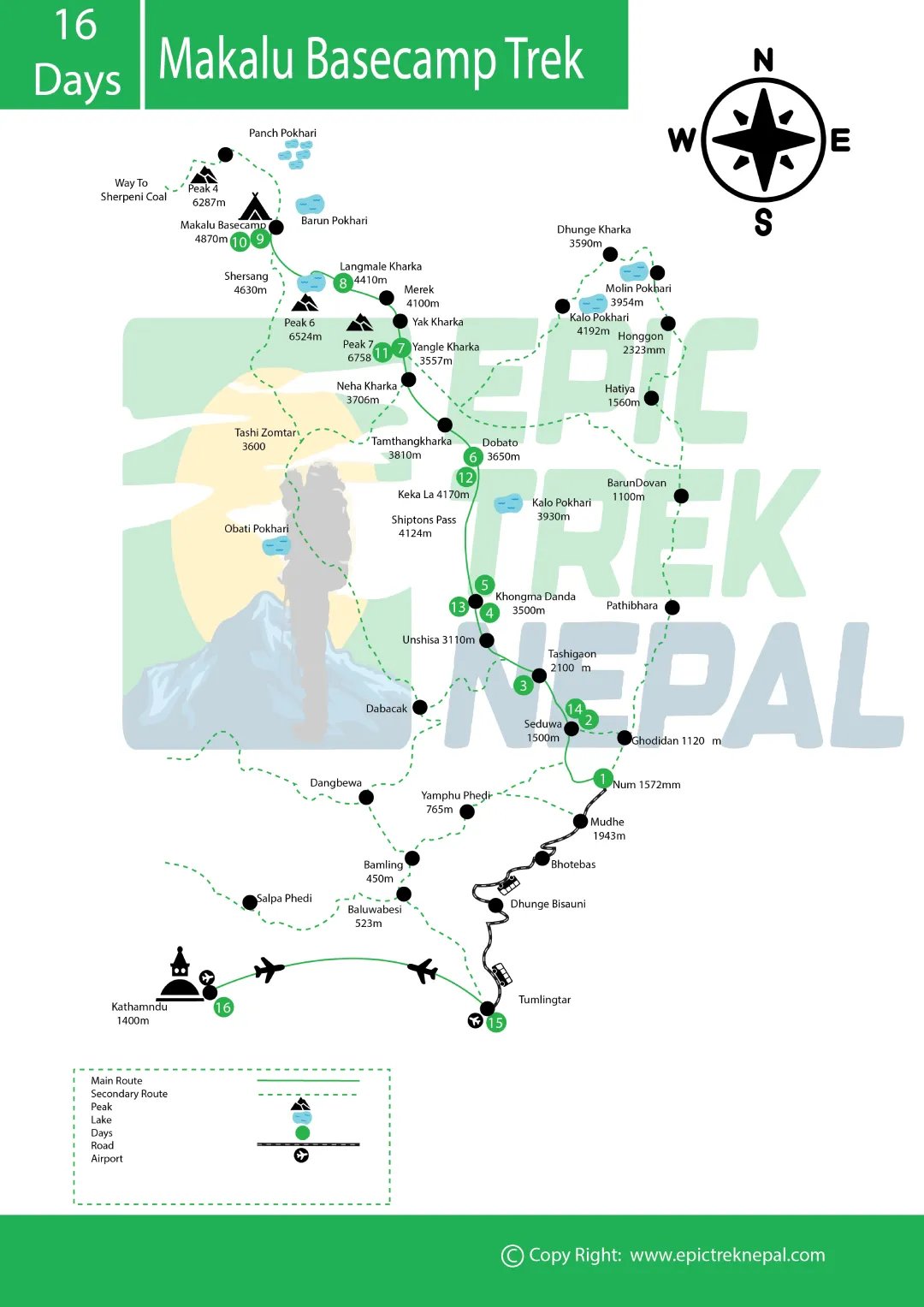
Trip Map of Makalu Base Camp Trek
Trip Information
How difficult is the Makalu Base Camp Trek
For a trek that is physically demanding, the Makalu Base Camp Trek requires a certain level of physical fitness and ability to keep up with the daily distances to be walked (5–7) hours depending on which portion of the path you take. Although no climbing skills are required, the Makalu Base Camp Trek demands endurance because each day the trekker will cover steep, rocky, and narrow trails.
The remote location of the Makalu Base Camp Trek is also a challenge as there are many fewer tea houses along the path than the busier treks within Nepal. Thus, the accommodations will be quite basic and the food will be simple, and a majority of the accommodation while on the trek will be very simple.
Altitude adds more challenge to this trek as the most challenging section occurs at 1500 m above sea level. Since there isn’t as much oxygen available at this altitude then your ability to acclimatize is essential if you want to avoid suffering from altitude sickness. An itinerary that encourages you to gradually adjust to the altitude at Makalu Base Camp is very effective at reducing your chances of developing altitude sickness while visiting the mountain.
Weather is another factor as it can change almost immediately with little or no warning. Therefore, cold temperatures and high winds plus occasional snow create an atmosphere that will challenge you from the day you arrive to when you leave. Anyone looking for an adrenaline-pumping adventure will find that the Makalu Base Camp View Trek is a challenging feat for individuals that enjoy an outdoor adventure and do not shy away from hard work!
Preparation for Makalu Base Camp View Trek
The trick of making the Makalu Base Camp Trek successfully is getting your preparations done correctly. Make sure that you have started training no less than 3 or 4 weeks prior to your departure date. Your goal here is to increase your endurance by such exercises as hiking, running, cycling, or working out on the treadmill at the gym. Strong leg muscles are a must for successful trekking.
Another thing you need to do is to get accustomed to moving about with a backpack because it will prepare your body for the actual situation. Don’t neglect the psychological part of the preparation either. Because of the remoteness and primitive facilities of the region, it is essential to make the necessary psychological adjustments.
Packaging equipment is also essential. You will require good quality footwear, warm clothes, a good sleeping bag, and a small first aid kit. Weather conditions cannot be guaranteed since they may either be sunny or freezing cold. As long as you stick to a good Makalu Base Camp trekking itinerary while incorporating sufficient rest periods, there’s nothing you can go wrong with.
Language and Communication on the Makalu Base Camp Trek
Trekking in the Makalu Base Camp Region of Nepal is a little more complex than trekking in other, more touristy areas of Nepal. The Makalu Base Camp Trek is located far out in eastern Nepal and passes through many villages that mostly speak Nepali and several dialects of Sherpa, Rai, and Bhotia. In lower villages like Num and Seduwa you will usually find someone who speaks a little English (especially at the teahouses, ie. the owners). But, as you go farther into the Makalu-Barun National Park, it will be much more difficult to find English speakers.
The best advice when trekking the Makalu Base Camp Region is to hire a good guide. Not only will your guide help you navigate the area, but they will also be your translator in the remote villages. Learning just a couple of words in Nepali, such as “Sanchai hunuhunchha?” (How are you?) and “Mitho chha” (It’s delicious), will go a long way towards establishing connections with local people. Since local residents in the Makalu Base Camp trek receive far fewer trekkers than in the Everest region, they really appreciate it when you try to communicate with nothing more than a few words of Nepali.
Cultural festival on the Makalu Base Camp Trek
This trail for trekking through Makalu Base Camp includes several authentic villages whose local communities perform these amazing cultural festivals. The majority of people in this region are representatives of ethnic groups such as Rai and Sherpa, who are known for their great culture and traditions that have been preserved for ages.
It may be possible to attend festivals like Sakela at Rai villages on this trip as well. This festival honors nature and the harvest through performing numerous traditional dances and songs. Sakela is typically organized during spring and autumn months.
And then there are the Sherpa communities with their Buddhist celebrations like the Lhosar festival, marking the New Year in Tibet. Such events are not to be missed because the monasteries are decorated to celebrate these festivals. There are chanting prayers and feasts organized at the monastery. Seriously, experiencing any cultural event gives your journey a whole different dimension altogether because it allows you to truly experience the culture and relate to the locals. The Makalu Base Camp trek is about seeing the magnificent Himalayas, but it is also about connecting with the locals. Adding such cultural events to your itinerary will make your trek more meaningful.
Mobile network, internet & charging facilities
If you are hoping to remain in touch 24 hours a day across the Makalu region, it may come as a surprise that this will be impossible to do. Mobile reception is reasonably good within Tumlingtar and Khandbari but when you leave these two towns and start travelling higher than Num, the network signal becomes unreliable. The best network provider to go with in this area is Nepal Telecom (NTC), as they have better network signal at the edge of the earth than Ncell. By the time you reach base camp or cross the Shipton La, do not expect your phone to do anything other than take pictures.
The internet is another story. There may be some Wi-Fi offered for a small cost in some of the teahouses in the lower villages, but due to the poor speed of the internet and unpredictable weather conditions, you may find it to be useless. The further up you go, the less internet connectivity you will have.
With regard to charging, the majority of tea houses have solar-powered chargers on the Makalu Base Camp view trek. It will not cost you much money (a few hundred rupees) to charge your devices, but be aware that depending on how cloudy the weather was that day, you may run into issues with the amount of energy that is available. What I would recommend doing is packing a large power bank as well as a small solar charger for your backpack.
Trip Extension
The Makalu Base Camp Trek has quite a few exciting extension opportunities and side treks if you are the kind of traveler who enjoys looking for new things beyond the map. For instance, you could continue on into the Upper Barun Valley. This is a good choice, considering it lies within the boundaries of the Makalu-Barun National Park, which means that you will be treated to an incredible diversity of plants and animals, ranging from glaciers and secret waterfalls to rarely seen wildlife species.
Another good idea would be to extend your stay at the base camp of Mount Makalu itself. Since the region is so vast, there are plenty of breathtaking viewpoints where you can take great photographs or even go on shorter hiking trips.
A few of the trekkers have even attempted linking up with some of the remote valleys that lie in close proximity provided they have the time and the required permissions. Such treks are not often followed by many people and can offer an experience of the true wilderness. But, you would need to be highly fit and plan their itinerary carefully for the same. You could also choose to combine such treks with visits to some of the cultural zones located around in the eastern regions of Nepal. Such treks offer both elements of nature as well as culture together.
Health and Safety on Makalu Base Camp Trek
Always remember that health and safety need to come first while you are Makalu Base Camp Trek. Since there is a risk of altitude sickness when trekking to more than 5,000 meters, walking slowly, drinking plenty of water, and following the acclimatization program will make it easy for you to minimize your risks.
Remember that you need to listen to what your body is telling you 24 hours per day. The instant you notice symptoms such as headaches, dizziness, and nausea, you should inform your guide.
Hygiene is another aspect you should not neglect either. Always make sure you wash your hands as much as possible and drink only clean water. It is recommended that you have at least basic medication such as cold, fever, or upset stomach drugs.
As the climate may quickly change in the Himalayan region, it will be important that you always have your rain gear and warm clothing on hand in your day pack. Having a professional guide when trekking will add even more security, particularly in very remote parts of the destination area.
Visa and Permits
When preparing for the Makalu Base Camp trek, there is one thing that you will definitely require, a Nepal visa. Most tourists simply acquire the required visas immediately upon their arrival at the airport of Kathmandu or the land borders. However, if you wish to save some time when processing, you could arrange the visa prior to arrival online.
Another crucial thing you should prepare in advance is the relevant trekking permits.
Required for All Trekkers:
- Makalu-Barun National Park Entry Permit:
It is the National Park Entry Permit issued by Nepal Tourism Board (NTB). You have to register and verify this permit at Num/Seduwa.Cost: NPR. 3,000 per person - Makalu Rural Municipality Permit:
It is the formal conservation area permit provided by local authority. This can be obtained at Kathmandu or at check points along the trail. Cost: NPR 2,000 per person - TIMS Card (Trekkers’ Information Management System):
This Card stores the data of trekkers and generally required for most trekkers in Nepal. Some agency state TIMS has been replaced by the Rural Municipality permit, but many continue to require and issue it. We recommend obtaining both to avoid complications. Cost: NPR 2,000 - Restricted Area Permit:
If your Makalu Base Camp Trekking Itinerary takes you through the Kanchenjunga Base Camp route and enters restricted villages like Chepuwa, Hatiya, Kimathangka, and Pawakhola. You require a special permit for Restricted Area. Cost: $20 per person per week for the first 4 weeks. Then USD 25 for a week per person for additional weeks. - Guide Requirement:
For certain areas, You must hire at least one authorized person from the local trekking agency in Nepal, either a professional guide or a licensed porter, particularly for restricted areas.
If you book your trek with Epic Trek Nepal, then we will handle your paperwork and permits just provide us:
- Copy of your passport
- Passport size photo.
Important: Ensure all permits are obtained before starting your trek to avoid delays or complications at checkpoints.
Don’t do on the Makalu Base Camp Trek
When trekking through Makalu Base Camp, here are a few mistakes you should avoid in order to have a safer experience. For starters, whatever you do, refrain from rushing your pace. Although you may want to move faster, doing so will only ensure that you fall victim to exhaustion or even altitude sickness. All you have to do is to pace yourself and pay attention to your own body.
You should never skip any acclimatization days on your Makalu Base Camp trekking Itinerary. Even though it will appear to be time-saving, skipping acclimatization will almost certainly result in experiencing serious altitude complications. Last but not least, try to avoid solo trekking at all costs. When trekking through more remote areas, having someone to accompany you, such as a guide or at least a small group, can be very important.
It is important that you avoid overloading yourself too. The weight of your backpack will definitely take its toll on you during your hiking day. Nevertheless, remember to pack all the necessities like clothing, shoes, and your medical kit.
Do not consume untreated water, or consume any kind of alcohol excessively, particularly at higher altitudes. Both of them have the ability to affect your hydration negatively. The last thing I want to stress about is the importance of respecting nature and the people around you, particularly in the context of this Makalu Base Camp view trek.
Travel Insurance
The Makalu Base Camp trek requires you to have your travel insurance sorted before you head out to the most remote places on the planet are at high altitudes. If there is ever an emergency, getting you out may only be achievable via helicopter and if you do not have suitable travel insurance then the cost will be very high and you will be responsible to pay it.
When travelling to the Makalu Base Camp trek, your travel insurance must include coverage for altitude trekking ( up to a minimum of 5,500 metres ), medical evacuation, treatment, cancellation of the trip, and for loss of personal items. Before paying for your insurance, you should always read through the whole policy to ensure you understand all terms and conditions.
Make sure to carry copies of your insurance with you. In addition, you should provide your guide and trekking agency all the information necessary to allow for them to access the information quickly if it is ever needed. Although trekking to Makalu Base Camp is a very beautiful and rewarding experience, it is still a very uncertain environment. As such, having travel insurance provides you with peace of mind and financial peace.
Frequently Asked Questions
Our itinerary covers 18 days, starting from Tumlingtar and passing through diverse landscapes before reaching the base camp at 4,870 meters.
Epic Trek Nepal pricing:
- Solo Trekker: $1,900 per person
- 2-3 person: $1,870 per person
- 4-6 person: $1,850 per person
- Group over 7: $1,800 per person
Includes all permits, accommodation, meals, guide, porter, and ground transportation (no flights required).
You’ll need:
Makalu Barun National Park Entry Permit – USD 25 per person
Makalu Rural Municipality Permit – USD 20/week for the first four weeks
Epic Trek Nepal will handle all permit arrangements for you.
It’s a moderate to challenging trek with steep climbs, high altitude, and remote trails. Good physical fitness and prior trekking experience are recommended.
The best times are Spring (March–May) and Autumn (September–November) for stable weather, clear skies, and excellent mountain views.
The highest point is Vantage Point at 5,300 meters (17,388 ft).
You’ll stay in local teahouses with basic facilities, plus a few nights in simple lodges or homestays in remote areas.
Yes, a licensed guide is mandatory for trekking in this region, and Epic Trek Nepal provides experienced, English-speaking guides.
It’s one of Nepal’s most untouched routes—home to rare wildlife, remote mountain villages, and breathtaking views of Makalu, the world’s fifth-highest mountain.
Yes, although the journey on its own can be quite difficult since it involves a path that is far from civilization. A guide is definitely advised because it would be much easier to navigate this way.
Typically, you will take a flight to reach Tumlingtar from Kathmandu. After landing at Tumlingtar, you have to make your way through a rough ride until you reach Num, where you begin your trekking journey.
Trip Reviews
US$ 1870
Need Help? Talk to Expert
+977 9764792172