




Renjo La Pass Trek
73 reviews in Tripadvisor

Trip Duration
13 Days
Destination
Nepal
Max. Altitude
5,360 m.
Trip Difficulty
Difficult
Group Size
1-12
Transportation
Flight
Accommodation
Hotel/Teahouse
Activity
Trekking
Meals
All Inclusive
Start / End
Kathmandu
Region
Everest
Best Season
Spring & AutumnUS$ 1280

Need Help? Talk to Expert
+977 9764792172Trip Overview
The Renjo La Pass Trek is one of those treks through the Himalayas that just quietly surprises you along the way. It is located in the Khumbu region of Nepal and takes you through some of the remotest valleys, traditional Sherpa villages, and high altitudes areas, where the air gets pretty thin, but the views are just endless. It is a pass at about 5,360 meters high, and standing up there gives you the massive, wide open view of the Himalayas.
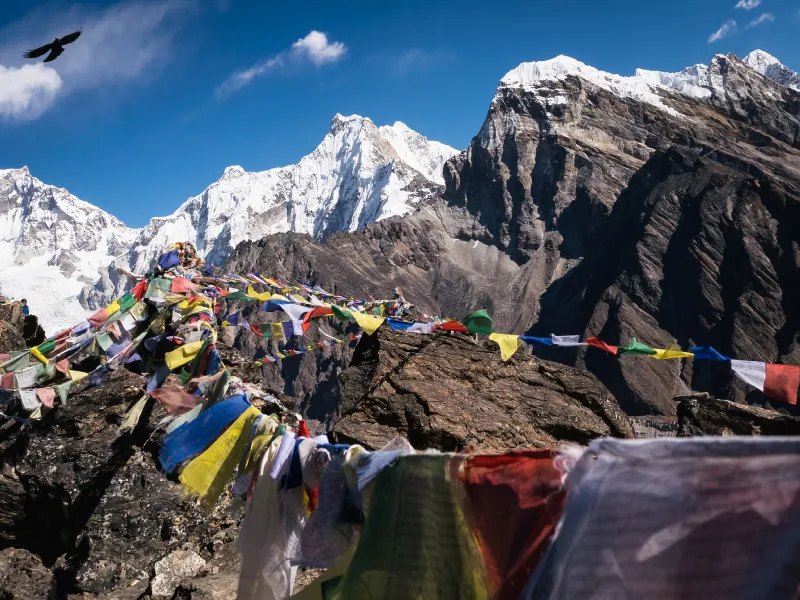
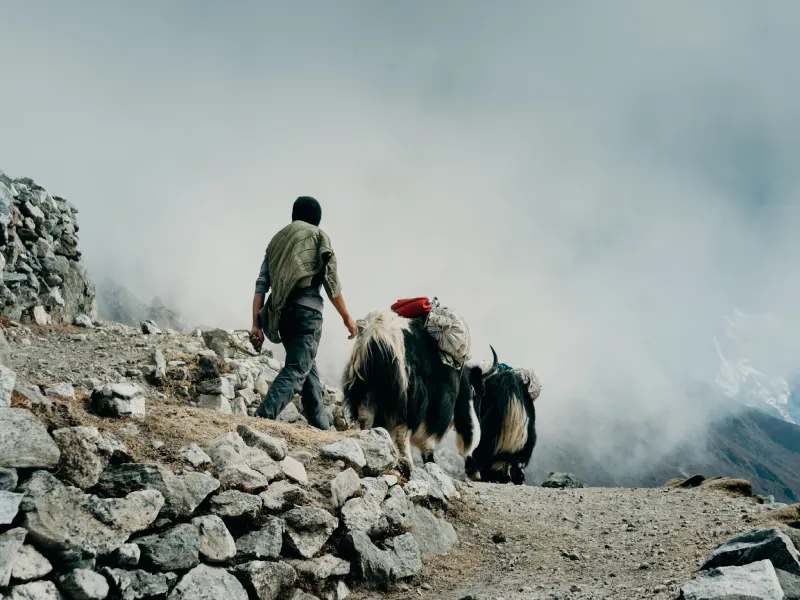
What a lot of trekkers like about this particular route is that it doesn’t feel overly crowded. While the Everest region is like, one of the most popular places on the entire planet, the Renjo La Pass somehow still has that quiet and peaceful vibe to it. The trails take you through forest, villages, and high altitude areas where you can see yaks just moving slowly across the hills. On the way you can also get a taste of the real Sherpa lifestyle, from the little tea houses to their traditions that have been going on for centuries.
The adventure generally starts with the flight to Lukla from Kathmandu. From there the trails starts through the Dudh Koshi Valley, through villages like Phakding and finally reached Namche Bazaar. Namche Bazaar is the hub of the Khumbu region, and this is the place where you get to see the culture of the mountains along with lively markets and teahouses.
After you leave Namche, the trails starts to move away from the crowds and into some quieter areas like Dole and Machhermo. Eventually you arrive at the magical turquoise Gokyo Lake. There are some some high altitude lake that are known for this incredible turquoise color, which doesn’t look real. Most people also choose to hike to Gokyo Ri while they are there, which is a viewpoint providing breathtaking views.
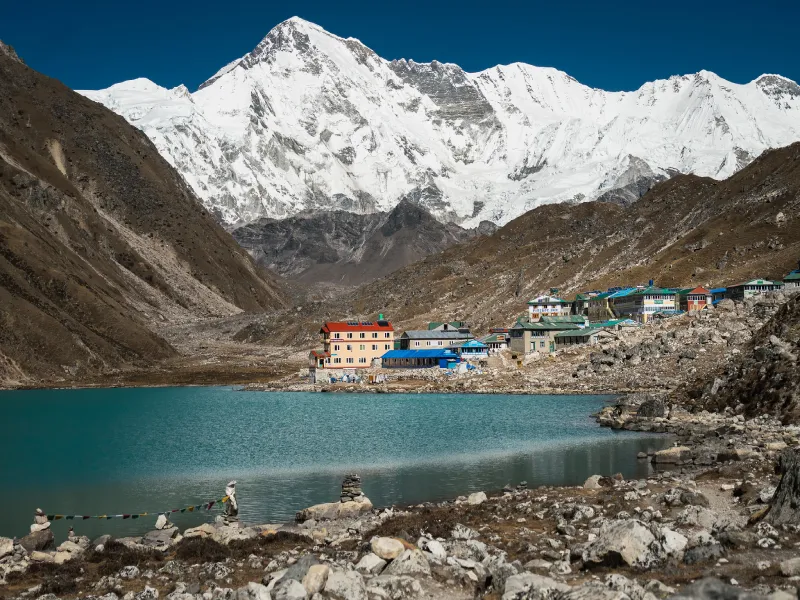
From Gokyo, you start the ascent to the Renjo La Pass. For most of the trekker this day is one of the most memorable days of the entire trek. The ascent can be a little tough, but once you reach the top, Well, the reward is huge. Once you reach the top of the pass, the route descends to Lungden and slowly makes its way back through the Khumbu Valley before you finally head back to Lukla.
It’s not just a trek over a high-altitude pass; it’s a trek through a different kind of scenery every single day, interacting with locals, and finding a relatively undiscovered area of the Himalayas that a lot of people kind of miss out on. I think, in a way, that’s perhaps what makes it a bit more special, in a way.
Best Time to Do the Renjo La Pass Trek
Spring (March to May)
Spring, which is from March to May, is definitely one of the most popular seasons to go out. In this period of time, the weather is starting to get warmer, and the sky is pretty clear. The lower hills and forests are covered with the beautiful rhododendron flowers, making the view quite lively. The view of the snowy mountains is quite sharp, especially if you wake up early. It’s quite a good time to take pictures, especially if you like the weather to be just right, not cold enough to hide inside your sleeping bag all day.
Autumn (September to November)
Another good period to visit would be autumn. Once the rains from the monsoon season clear all the dust from the air, the mountain vistas look extremely crisp and clear. The weather is usually pretty stable during this time, and a lot of trekkers prefer to come during this time since the chances of getting clear blue skies are high. The villages route also seem to be pretty active during this time since it’s peak trekking season.
Winter (December to February)
Winter, which spans from December to February, is not as busy. Like, not even close. There are a lot fewer people on the trail, and for some people, this is actually kind of awesome because it’s just so peaceful. However, you have to be prepared for the cold because it gets pretty chilly, especially when you’re going up to the pass and the area of Gokyo because it could snow.
Monsoon (June to August)
Monsoon season, from June to August, is certainly not the best time to visit. You’ll experience rain almost daily in the lower areas, and the trails can be quite muddy and slippery at some points. In addition, flights to Lukla can be delayed during the monsoon season because of the clouds. On the other hand, the scenery is lush green during the monsoon season, and you may not encounter other trekkers at all during your trip.
Highlights of Renjo La Pass Trek
- Cross the breathtaking Renjo La Pass (5,360m), one of the most picturesque high passes in the Everest region.
- Stay at local tea houses and mountain lodges to experience the hospitality of the Himalayas.
- Views of Mount Everest, Lhotse, Makalu and other smaller peaks.
- Visit the Gokyo valley and its turquoise color Gokyo Lake.
Renjo La Pass Trek - Distance, Duration, and Altitude
| Trekking Route | Distance (Kilometers) | Duration (Hours) | Altitude (Meters) |
|---|---|---|---|
| Kathmandu to Lukla Flight & Trek to Phakding | 8 KM | 35 min flight and 3 to 4 hour Trek | 2651 m. |
| Trek from Phakding to Namche Bazaar | 10 KM | 5 to 6 hours Trek | 3438 m. |
| Trek from Namche Bazaar to Phortse Thang | 6 KM | 5 to 6 hours Trek | 3680 m. |
| Trek from Phortse Thang to Machhermo | 8 KM | 5 to 6 hours Trek | 4470 m. |
| Machhermo to Gokyo | 6 KM | 3 to 4 hours Trek | 4790 m. |
| Trek to Gokyo to Lumde via Renjo La Pass | 11 KM | 8 to 9 hours Trek | 4368 m. |
| Trek to Lumde to Namche Bazaar | 18 KM | 7 to 8 hours Trek | 3440 m. |
| Namche Bazaar to Lukla - Last day of Trek | 19 KM | 6 to 7 hours Trek | 2839 m. |
Itinerary of Renjo La Pass Trek
Day 1: Arrival in Kathmandu
Your adventure begins as soon as you touch down at Tribhuvan International Airport. When you get through customs and collect your luggage, we will pick you up and take you to your hotel. Honestly, just chill out tonight because the altitude acclimatization process begins today. You can walk around the local streets, eat some local cuisine, and get a good night’s sleep because the real adventure begins tomorrow.

Activity: Arrival

Max. Altitude: 1400m./4,593ft.

Meal: Dinner

Accommodation: 3 Star Hotel
Day 2: Kathmandu to Lukla Flight & Trek to Phakding
It’s an early start today as we take the famous flight to Lukla. It’s only a short flight of around 35 minutes, but the views from up high are just incredible. If the weather is nice, you can see Everest popping out of the clouds in the distance. When we land at Lukla, we officially start our trekking adventure. Today’s trek to Phakding is quite gentle as we walk through the pine forests and cross a few of those famous suspension bridges. We arrive at Phakding in the afternoon and just enjoy the sunset over the mountains.
Activity: 35 min flight and 3 to 4 hour Trek
Max. Altitude: 2651m./8,698ft.
Meal: Breakfast, Lunch, Dinner
Accommodation: Tea house
Day 3: Trek from Phakding to Namche Bazaar
After having breakfast the day gets a bit more serious. You’ll be following the river along the Dudh Kosi River, seeing mani walls and many more bridges. Today’s a bit of a grind as you climb steadily up to Namche Bazaar. Namche’s the hub of the Sherpa community. Everything’s here from bakeries to gear shops. It’s a good place to hang out and take in the Tibetan atmosphere once you arrive.
Activity: 5 to 6 hours Trek
Max. Altitude: 3438m./11,280ft.
Meal: Breakfast, Lunch, Dinner
Accommodation: Tea house
Day 4: Acclimatization day in Namche Bazaar
This day is extremely important in your trekking experience because it gives your body a chance to acclimatize to the high altitude. Normally, we take a day hike up to the Everest View Hotel to enjoy a tremendous view of Mount Everest, Lhotse, and Ama Dablam. If you are feeling good, you could also head down to Khumjum village and visit the Hillary School and old monasteries. You will return to Namche in the late afternoon to rest and enjoy a good meal.
Activity: Acclimatization and Short Hike
Max. Altitude: 3438m./11,280ft.
Meal: Breakfast, Lunch, Dinner
Accommodation: Tea house
Day 5: Trek from Namche Bazaar to Phortse Thang
On the fifth day, you’ll be climbing out of Namche Bazaar. Along the way, you’ll go through some rhododendron forests, which are quite pretty, as well as some yak fields where the yaks are usually hanging out. It’s a moderate hike, maybe 5 or 6 hours. You’ll also get to see some traditional Sherpa villages and a lot of prayer flags along the way. Once you arrive at Phortse Thanga, you can just sit back, relax, and enjoy the sunset on the mountain peaks.
Activity: 5 to 6 hours Trek
Max. Altitude: 3680m./12,073ft.
Meal: Breakfast, Lunch, Dinner
Accommodation: Tea house
Day 6: Trek from Phortse Thang to Machhermo
On the sixth day, you’ll notice that the trees are starting to disappear, and the terrain is getting a lot more rugged, almost like the moon. You’re climbing up into the alpine zone now. Along the way, you’ll go through some small villages and gompas. Machhermo is a small village, but it’s a good acclimatization point. Take a look around, check out the view of Cho Oyu, and try to drink plenty of water because you’re at a pretty high altitude now.
Activity: 5 to 6 hours Trek
Max. Altitude: 4470m./14,665ft.
Meal: Breakfast, Lunch, Dinner
Accommodation: Tea house
Day 7: Machhermo to Gokyo
Today you will be walking over moraine ridges and glacial streams as we make our way to Gokyo. The lakes are the definite highlight of the day with its turquoise color which look unreal and magical at the same time. This will be a relatively short day’s trekking, maybe 3 or 4 hours. This will give us time to explore the village and just gaze at the bright blue glacial lakes.
Activity: 3 to 4 hours Trek
Max. Altitude: 4790m./15,715ft.
Meal: Breakfast, Lunch, Dinner
Accommodation: Tea house
Day 8: Acclimatization at Gokyo and Hike to Gokyo Ri
Another day of acclimatization which basically just means we will be hiking again. This time we will be hiking to Gokyo Ri. This hike will a bit slow, taking us 3 or 4 hours round trip. However, the views from the top are arguably the best in the Himalayas. We can see Everest, Makalu, and the massive Ngozumpa Glacier all at the same time. Then it’s back down for a well-deserved dinner and a long night’s sleep.
Activity: 3 to 4 hours hike
Max. Altitude: 5360m./17,585ft.
Meal: Breakfast, Lunch, Dinner
Accommodation: Tea house
Day 9: Trek to Gokyo to Lumde via Renjo La Pass
Well, this is the big one! This is the hardest day of the trek, but also the most rewarding, and you get to go over the Renjo La Pass today! Yes, the altitude is high, and the walk up to the top is steep, but when you get to the top, you can see just how high you’ve climbed and the view from the top is great! It’s a long day’s trekking today, and you’ll be on the move for about 8 to 9 hours, so make sure you get an early start.
Activity: 8 to 9 hours Trek
Max. Altitude: 4368m./14,331ft.
Meal: Breakfast, Lunch, Dinner
Accommodation: Tea house
Day 10: Trek to Lumde to Namche Bazaar
Today is a nice long walk back down to Namche Bazaar after the completion of climbing the Renjo La Pass! It’s a nice walk through some of the local valleys and some nice areas of pine trees. It’s nice to breathe the thick air of Namche Bazaar again! You could celebrate your successful completion of the trek with a nice cup of coffee or a local food from one of the markets!
Activity: 7 to 8 hours Trek
Max. Altitude: 3440m./11,286ft.
Meal: Breakfast, Lunch, Dinner
Accommodation: Tea House
Day 11: Namche Bazaar to Lukla - Last day of Trek
The final day of the hike is here, and it’s time to head back down through the forest and over the suspension bridges one more time. You’ll be heading to Lukla, but it’s a long hike, so it’s a good thing it’s downhill the whole time. Your lungs will thank you. Once you arrive at Lukla, it’s time to celebrate with the crew. You’ve earned it!
Activity: 6 to 7 hours Trek
Max. Altitude: 2839m./9,314ft.
Meal: Breakfast, Lunch, Dinner
Accommodation: Standard Tea house
Day 12: Lukla to Kathmandu
It’s time to say goodbye to the Himalayas, but you’ll still get to see the beauty of the mountains one more time. You’ll take an early flight back to Kathmandu. Once you land, we’ll bring you back to the hotel. You’ve got the rest of the day to do whatever you’d like. How about doing a little shopping for souvenirs in Thamel or grabbing a celebratory meal and drink. In the evening, enjoy a complimentary local dinner hosted by our company to celebrate your successful completion of Renjo La Pass Trek !
Activity: 35 min Flight
Max. Altitude: 1400m./4,593ft.
Meal: Breakfast
Accommodation: 3 Star Hotel
Day 13: Final Departure
Your home return day, as according your scheduled flight departure time. You will be transferred to the TIA with a lifetime memory of your journey to Renjo La Pass.
Farewell until next time !
Includes/Excludes
What is included?
- Permits and Fees: All necessary permits for the Renjo La Pass Trek, such as the Sagarmatha National Park Permit and the TIMS (Trekkers’ Information Management System) card.
- Accommodation: Accommodation during the trek, typically in teahouses or lodges. This usually includes accommodation in Kathmandu before and after the trek in 3 star hotel on BB plan. (twin sharing basis)
- Meals: Most packages will include three meals a day (breakfast, lunch, and dinner) during the trek. also includes two times hot beverage (in breakfast and lunch) and seasonal fruits after dinner.
- Domestic Flights: Round trip flights between Kathmandu and Lukla, the starting and ending point of the trek, are usually included.
- Guide and Porters: Services of an experienced English-speaking trekking guide and porters to carry luggage(one porter for two trekkers). This includes their salary, insurance, equipment, transportation, food, and accommodation.
- First Aid Kit: A basic first aid kit is typically provided.
- Trekking Map: A detailed map of the trekking route is usually included.
- Equipment: Duffle Bag, Sleeping Bag (if necessary)
- Pick up drop-off: airport pick up and drop-off by private vehicle.
What is not included?
- International Flights: International airfare to and from Nepal is not included.
- Travel Insurance: Travel insurance that covers emergency rescue, evacuation, and medical treatment is not included, and you’ll be expected to have your own.
- Personal Expenses: Expenses for extra meals, drinks, snacks, charging devices, hot showers, Wi-Fi, laundry, and other personal costs are not included.
- Nepal Visa Fees: Entry visa fees for Nepal are not included.
- Additional Accommodation and Meals: If you choose to extend your stay in Nepal, or if you return from the trek earlier than scheduled, the cost of additional accommodation and meals will not be included.
- Rescue and Evacuation: Any costs related to emergency evacuation or rescues are not covered.
- Trekking Gear: Personal trekking equipment, such as hiking boots, down jackets, trekking poles, and other gear are not included.
- Tips: Tips for guides and porters are not included and are left to your discretion.
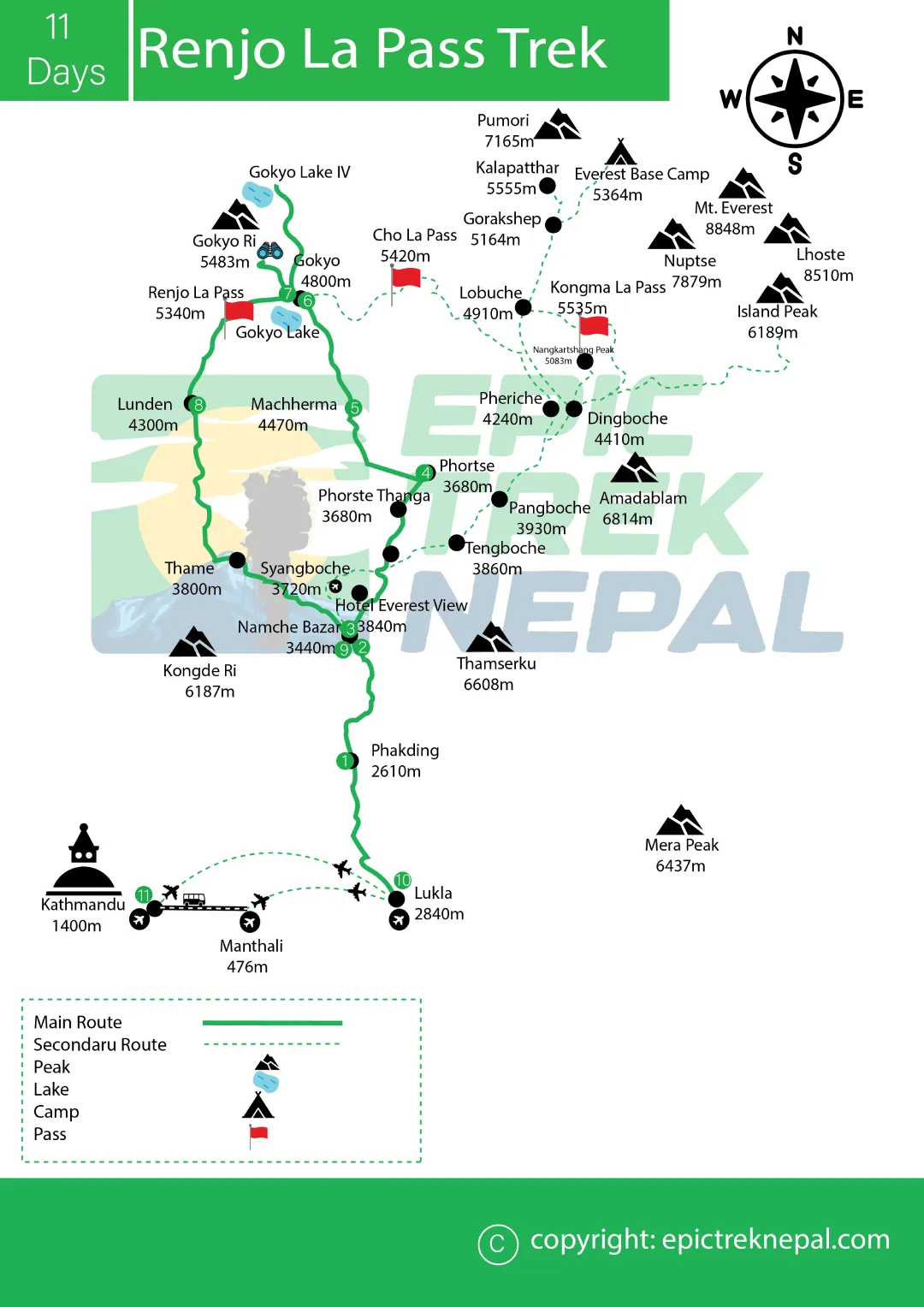
Trip Map of Renjo La Pass Trek
Trip Information
Trek Difficulty
The Renjo La Pass trek is considered a moderately difficult to difficult trek. It’s certainly not a walk in the park or anything like that, but at the same time, it’s certainly something that tons of people are able to complete as long as they’ve got the right mindset and a bit of experience under their belt. The biggest challenge that you’re going to face is the altitude, as the pass sits high up at an impressive 5,360 meters. This means that you can expect to walk a bit slower and get a bit winded as you make your way through the trek.
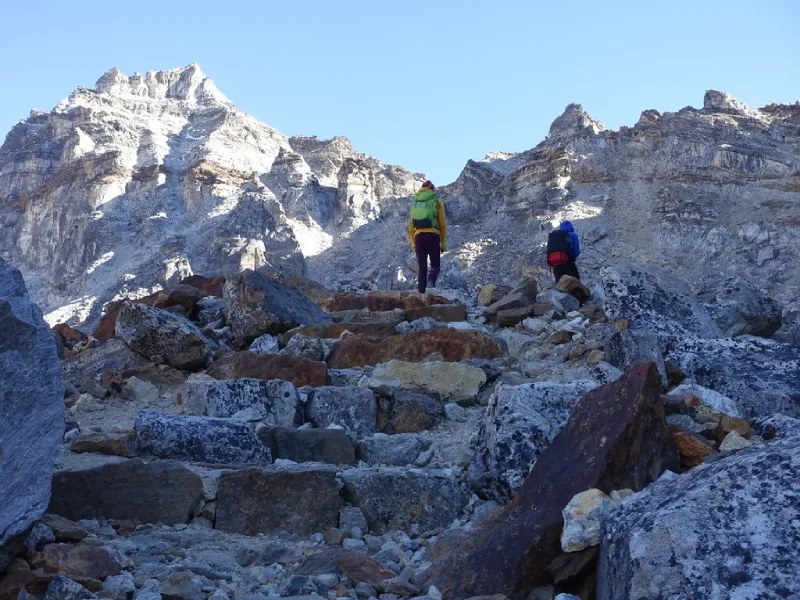
On a daily basis, you’re talking about 5 to 7 hours of actual trekking time, depending on how fast the group is moving and what the trail is like. Some days are pretty short and relaxing, but other days, particularly the day you’re actually crossing Renjo La can be pretty long and pretty hard on the legs. The trails are a mix of everything: you’re climbing, you’re on rocks, you’re at high altitude where the weather can change in an instant, so you gotta be ready for anything.
While it is true that being physically fit helps, let’s be honest, you do not need to be a professional athlete or mountain climbing expert to accomplish this feat. In fact, we see first-time trekkers complete the entire loop every single year. What it comes down to is just taking it slow, letting the body adjust to the thinner altitude, and just drinking a lot more water than you think you should.
Being prepared also goes a long way. Just doing a little hiking or cardiovascular exercise before the trek, bringing the right equipment, and ensuring that your itinerary has enough acclimatization days built in can make a huge difference. If you have a good plan in place and pace your itinerary well, the Renjo La Pass Trek isn’t just something that can be done; it can be done in a highly rewarding way that you will enjoy.
Food on the Renjo La Pass Trek
The food on the trail is surprisingly varied, which is usually a shock to people. There is usually a menu at the tea houses that offers a few simple, filling meals that will give you the energy boost you need from all the walking. The staple dish is definitely the dal bhat, just the classic Nepali dish of rice, lentil soup, veggies, and perhaps some spicy pickles. It’s a favorite for a reason, and the best part is that refills are usually free.
Besides the dal bhat, you’ll probably find foods like fried rice, noodles, pasta, veg curry, and momos in most of the lodges. Breakfast options like pancakes, porridge, eggs, toast, and plenty of tea/coffee are available along the route. Drinks like ginger and lemon tea, and milk tea are pretty much a staple on the route and are great for warming your hands up.
While the food may not be fancy compared to what you can get at a city restaurant, it’s homey, fresh, and made right there in the lodge. After a long day spent out in the cold mountain air, a simple bowl of soup or plate of noodles tastes like the best thing you’ve ever had.
Accommodation During the Renjo La Pass Trek
During the Renjo La Pass Trek, you will mostly be staying in local tea houses or mountain lodges along the trail. These are pretty simple accommodations, but they’re actually quite cozy and run by local families who know how to make you feel at home. Most of the rooms are pretty basic, usually with two beds, a thick blanket, and maybe a table if you’re lucky. Of course, it’s not exactly luxurious or anything, but honestly, they’re clean and feel like heaven after a day of trekking through the mountains.
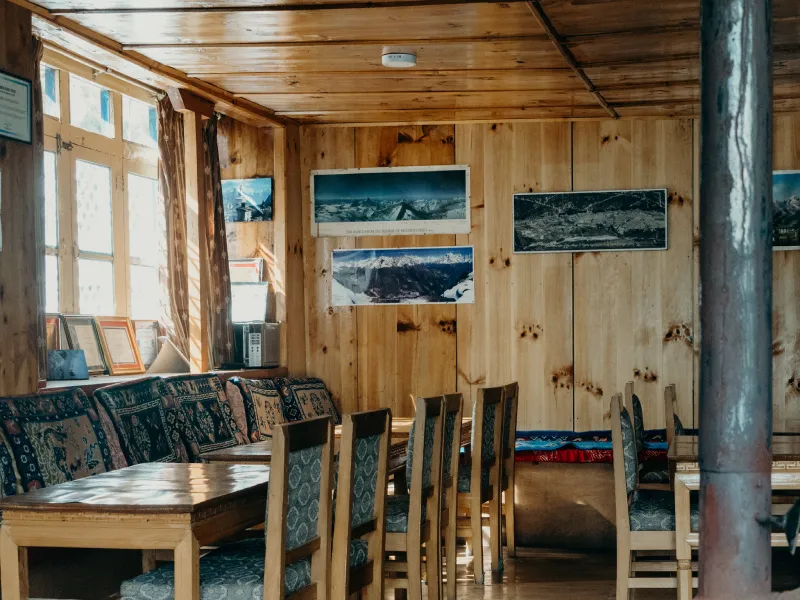
In the lower villages, some places may even offer bathrooms with their own facilities, but as you go higher up the mountain, things definitely get more authentic. In many cases, the bathrooms are shared, and a hot shower may run you a little extra money. Even with the simple rooms and food provided, most people fall in love with the dining rooms because all trekkers gather around at night to share experiences and stories around the warm stove which creates a memorable moment.
Cultural Experience in Renjo La Pass Trek
The Renjo La Pass Trek is not just about crossing mountain passes and enjoying in the glory of the massive Himalayas. Although, it is absolutely breathtaking. It’s also, a true journey into the heart of the Sherpa people in the Khumbu. As you go from one village to the next, you really start to see how people live up here in the clouds. They’ve been living among these mountains for generations, and the way they do things, the way they speak, is just so connected to the mountains and the Buddhism.
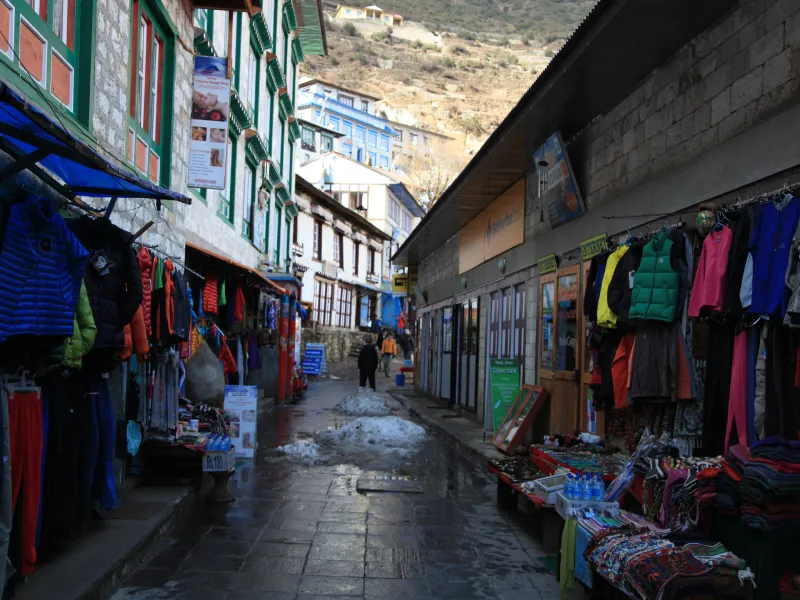
Walking along the trail, you will pass through areas like Namche Bazaar, Dole, Machhermo, and those little settlements around Gokyo. These villages have stone buildings, prayer flags flying high, and little monasteries that highlight the spiritual aspects of the region. You will see people spinning prayer wheels as you trek or monks moving from one monastery to another. These things may seem insignificant at first, but they give you a much better feel for the history of the region.
Another very special aspect of the entire trek is that you get to stay in the local tea houses. Most of the tea houses are run by Sherpa families, and they’re just very friendly people. It’s just great to sit there and have a simple chat with them in the evenings around the fire. Along the way, you get to see yaks carrying their loads, people working on their small fields, and children making their long walk to school along those mountain paths. It’s experiences like these that just give you a true idea of what life is like at high altitude, and for many trekkers, that’s just as impressive as the mountains.
Required Permits for Renjo La Pass Trek
Before you actually begin your Renjo La Pass Trek journey, there are a couple of really important things that you need to sort out to ensure that everything is legal and that you are trekking safely. This is because these documents will be checked at various points along the trail, so it’s a good idea to have them ready to go before your journey begins
First of all, there is the Sagarmatha National Park Entry Permit. Well, basically, the trekking trail passes through this national park. So, it is a must for any foreign trekker to have this permit. You can obtain this permit from the Epic Trek Nepal. But, trust me, it is not too difficult to obtain the permit in Lukla even before the trekking journey starts. The reason for the permit is to make sure that the environment is protected as well as to make sure that all people have a chance to trek through this environment.
The second one that you will need to acquire will be the Khumbu Pasang Lhamu Rural Municipality Permit. This one will be required if you are planning to trek through the villages in the Khumbu region that are not exactly within the boundaries of the national park. By acquiring these two permits, your trekking will be done within the law, and most importantly, will be helping the local communities that you will be passing through during your journey. If the service is provided by the Epic Trek Nepal, we will handle the paperwork and provide licensed guides for you to ensure safety.
What to Pack for Renjo La Pass Trek:
While you are packing for your Renjo La Pass Trek, make sure porters are also trekking with you. They are different from a guide; rather they are just to carry your stuff from Lukla. And also, there is limited weight you can take through the airport.
Here is the basic list of other things to pack:
- Sleeping bag
- Lightweight down jacket
- Waterproof jacket
- Moisture-Wicking Base Layers
- Insulating Layers
- Rain Poncho
- Gaiters
- Hiking boots
- Thermal Socks – 2 pair
- Long Underwear – 2 sets
- Sweatshirt
- Gloves
- Clothing to wear overnight, such as tracksuit
- Quick-drying underwear that you can hand wash on acclimatization days
- Warm hat and sunhat
- Sunglasses
- Personal medications and first-aid items (Guides carry the basic first aid kits)
- Sunscreen
- Hand sanitizer and biodegradable wet wipes
- Bar or liquid soap
- Toothpaste and toothbrush
- Toilet rolls or tissue packets
Also, bring snacks for yourself and chocolate bars for carbohydrates, and most importantly you must stay hydrated during the trek. For clean water, take the reusable bottle and tea houses will provide you with hot water at low cost or we’ll provide you with the purification tablets, use them alternatively for safe drinking water.
Cancellation Policy for Renjo La Pass Trek:
At Epic Trek Nepal, we understand the changes in plan unexpectedly. That is why we designed it to be fair and clear.
Cancellation Notice:
if you decide to cancel your trek for any reason, please make sure to inform us at least 7 days before your scheduled Trek start date.
Administrative Fee:
When a cancellation is made, 25% fee will be reduced from the total cost of trek as administrative fee. This fee covers the planning, preparation and booking cost we’ve already done for your trek.
Non-Refundable Period:
For any cancellation made within less than 4 days before the trek start date, no refund will be provided but by looking at the situation, if we feel the reason for cancelation is valid, then the amount will be refunded after deducting 70% of the total trek amount, as we have already submitted the cost and reserved the spots for you.
Documentation Support:
We know insurance claim can be important. In-case if you cancel, we would provide the necessary document such as receipts to help with your insurance process.
Unused Accommodation:
Please note that we cannot offer refunds for unused accommodation or services, if your trek is cancel due to personal reasons, illness or bad weather.
If you have questions or want to discuss your situation, our team is here to help. We appreciate your understanding and look forward to guiding you safely on your Renjo La Pass Trek.
Frequently Asked Questions
Renjo La Pass Trek is moderately challenging trek which is not a walk in the park, mostly because of the altitude being above 5000 meter. But if you have a decent level of fitness, you can handle it just fine.
Spring (March to May) and Autumn (September to November) are the best seasons to do this trek. Spring is beautiful because the rhododendrons are all out. Autumn is just famous for the clear blue skies after the rain.
You will need 2 permits: the Sagarmatha National Permit, and the Khumbu Pasang Lhamu Rural Municipality Permit.
Not at all! You do not have to be a professional climber, but it does help if you are in good physical condition. It’s not so much a test of skill as a test of endurance and patience with your body as it tries to adjust to the high altitude. As long as you are able to walk a few hours a day and are not afraid of a bit of a climb, you will be fine.
The standard route is about 13 days start to finish. Some days are short—maybe only 3 or 4 hours—while the big day over the pass can be 8 or 9 hours. It really depends on the terrain and how everyone is feeling that day.
Yes, it is necessary to have a guide and porter. Epic Trek Nepal has a great team of experienced guides and porters. Having someone to carry the heavy lifting and navigate the tricky bits makes the whole experience way more relaxed and, honestly, more fun.
You’ll get a bit of signal in bigger spots like Namche Bazaar and Gokyo, but once you get into the higher, more remote stretches, it’s pretty much a blackout.
Trip Reviews
US$ 1280
Need Help? Talk to Expert
+977 9764792172