Ruby Valley Trek
80 reviews in Tripadvisor
Trip Duration
7 DaysDestination
NepalMax. Altitude
3,842 m.Trip Difficulty
ModerateGroup Size
1-12Transportation
Private VehicleAccommodation
Hotel/HomestayActivity
TrekkingMeals
All InclusiveStart / End
KathmanduBest Season
Spring & Autumn
Need Help? Talk to Expert
+977 9764792172Trip Overview
Located in the Ganesh Himal area, the Ruby Valley Trek is one of the best-kept treasures of Nepal. While most travelers move towards Mt. Everest or Annapurna, this hidden gem is reserved for the curious adventurers that dare to wander for the off beaten path.
The Ruby Valley trek takes its name from the Ganesh Himal mountains where there are tales told by locals about rubies once residing within these hills. No one knows how true these legends are, but one thing is certain; the mystery remains present in every valley along the way.
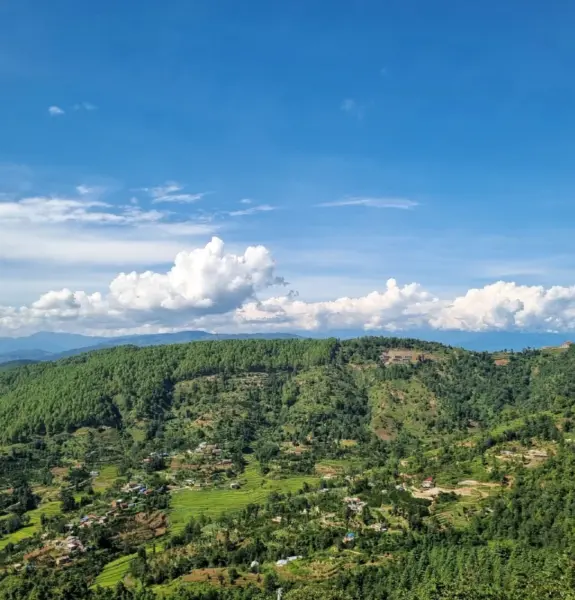
What sets this trek apart is its purity and untainted beauty. You will trek through rhododendron forests, through quiet rivers, and through terraced fields that have been shaped out by generations of farmers over years of hard work.
The natural scenery that this trek offer is truly equals anything that can be seen along any well-known trekking route in Nepal. Imagine waking up early one day and being able to see the stunning mountains of Ganesh Himal, Manaslu, and even the far-off Langtang range.
But that is not where the uniqueness ends, this trek allows you to get a feel of the Tamang and Gurung culture through their villages that still retain their old customs and treat visitors with true warmth and hospitality.
You will find that wildlife is another attraction here in Ruby Valley. Do not forget to look out for such animal as Himalayan black bears, red pandas, and the birds which have a large number of different species along the route. Forest feels alive on every step of the way.
This Ruby Valley Trek Itinerary will ensure that you do not miss anything along the way. Every single day will be unique and full of surprises. From unexpected waterfalls to stunning views from above, all of that will be waiting for you during the hike.
Trek Highlights
Ruby Valley Trek comes packed with diverse adventures that very few others can offer you. These are some of the things that make this trek such an incredible experience for you.
Panoramic Mountain Views
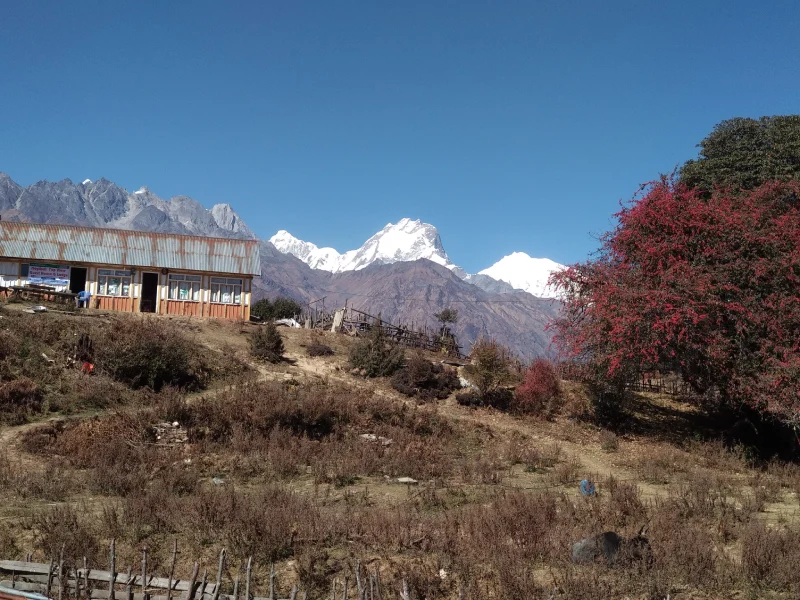
You get the opportunity to witness the mazing panoramic views of Ganesh Himal, Langtang, Manaslu and Annapurna on a clear day. Every view on the trail is from a unique point, which makes each of them more exciting than the previous one.
Village Life
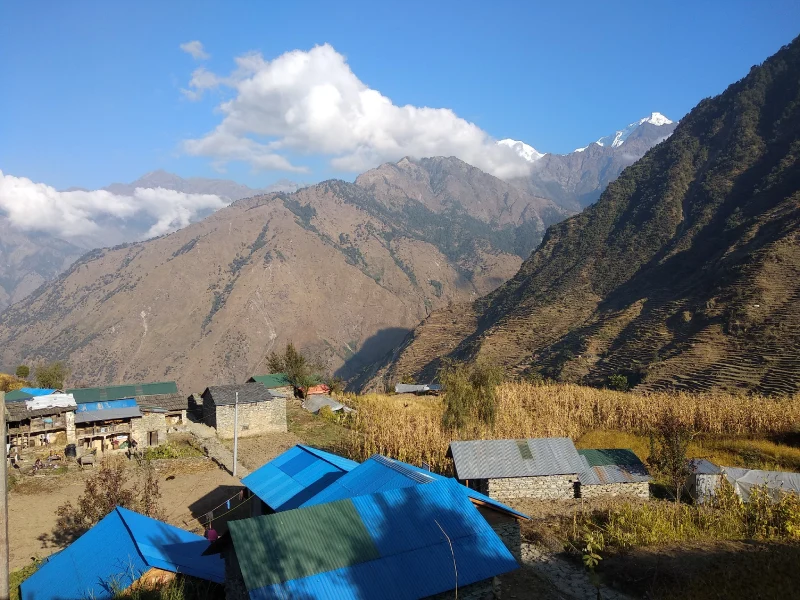
Throughout your trek, you will mostly see Tamang and Gurung Village which have not really changed their lifestyle throughout the time. These villages take you back into a time when everything was simpler.
Homestay Experience
Unlike many other trips where you would stay in typical tea houses, you will experience the local life by living in a local family’s house.
Natural Hot Springs
There is nothing better than having a bath in the hot springs in Chalish Village. After all the days of walking and trekking, there is nothing more relieving than sitting in water which is rich in minerals.
Forest of Rhododendron
As most part of the route consists of dense forest, they are most spectacular in the spring. Rhododendron trees and wildflower create an environment of serenity and calmness.
A Peaceful Route
Not as busy and crowded as others, this route remains peaceful through the whole journey. You get the opportunity to enjoy solitude for the greater part of your journey.
Hospitality of the Locals
Hospitality here is at its best. Trekkers do not get treated as tourist instead they are treated as guest. This experience makes trekking pleasant.
This combination of features makes Ruby Valley Trek Itinerary perfect and memorable.
Highlights of Ruby Valley Trek
- Panoramic view of the Ganesh Himal, Langtang, Manaslu, and even Annapurna mountain ranges on a sunny day
- Climbing up Pangsang Pass, which stands tall at 3,842 meters above sea level, which is the highest point on this trekking route
- Witness authentic Tamang and Gurung villages throughout the entire trekking route
- Experience true homestays and hospitality offered by local people
- Parvati Kund, which is considered as a sacred lake among Hindus as well as Buddhists
- A quiet trek alternative compared to more popular treks like Everest or Annapurna
- Stone architecture and monasteries hidden away in the village of Gatlang
Photo Gallery & Video Gallery
Ruby Valley Trek - Distance, Duration, and Altitude
| Trekking Route | Distance (Kilometers) | Duration (Hours) | Altitude (Meters) |
|---|---|---|---|
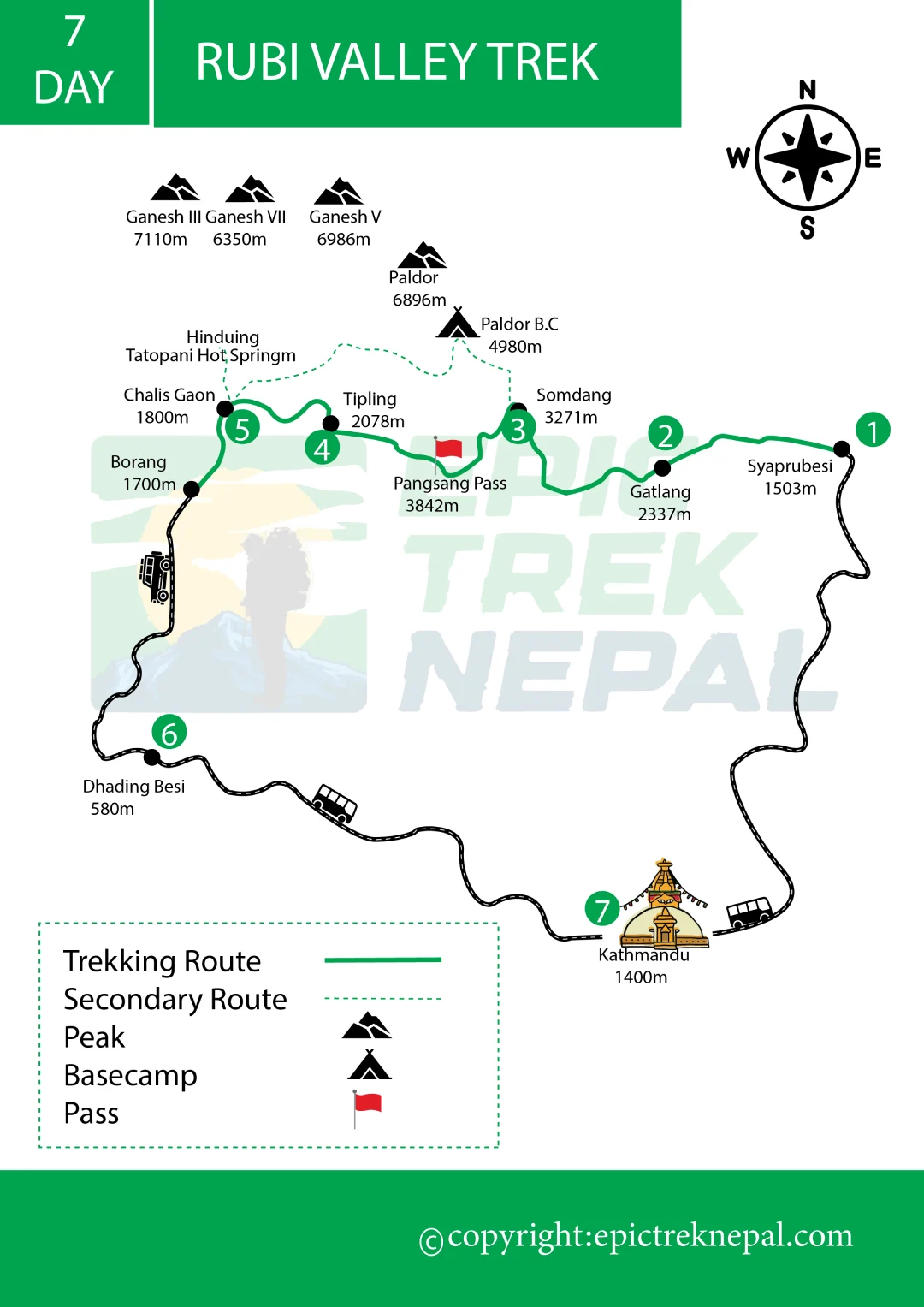
| Trek from Syabrubesi via Chawater to Gatlang | 13 KM | Trek (5 to 6 hours) | 2337 m. |
| Trek from Gatlang to Parvati Kund, Yuri Kharka to Somdang | 15 KM | Trek (6 to 7 hours) | 3842 m. |
| Trek from Somdang via Pangsang Pass | 14 KM | Trek (6 to 7 hours) | 3842 m. |
| Trek from Tipling to Chalish Goan | 5 KM | Trek (2 hours) | 1800 m. |
| Trek from Chalish to Borand | 72 KM | Trek (2 to 3 hours) + Drive (4 to 5 hours) | 1700 m. |
Itinerary of Ruby Valley Trek
Day 11: Drive from Kathmandu to Syabrubesi
The Ruby Valley Trek starts with a journey of scenic drive from Kathmandu to Syabrubesi. You will climb through hills and cross rivers, little villages and cultivated fields all along the way.
With increasing height, you will be able to see the scenery change from city area to rural mountain landscape. Syabrubesi lies in the Langtang region and starting point of the trek, so it might be little crowded at this place.
After reaching the place in the evening makes sure that you have enough time to prepare for the journey ahead of you.
Activity: Drive (7 to 9 hours)
Max. Altitude: 1503m./4,931ft.
Meal: Lunch, Dinner
Accommodation: Lodge
Day 2: Trek from Syabrubesi via Chawater to Gatlang
The trekking begins after you leave Syabrubesi and ascend gradually to Chawatar, where you will stop for lunch and catch your breath. Many parts of this itinerary are covered in forest trails and serene rivers.
The trek will continue upwards after lunch to reach Gatlang, a picturesque Tamang settlement known for its stone building and ancient monasteries.
The locals still practice tradition that seem untouched by tourist, and this is one of those parts of itinerary where you get to experience the rich culture quite early.
Activity: Trek (5 to 6 hours)
Max. Altitude: 2337m./7,667ft.
Meal: Breakfast, Lunch, Dinner
Accommodation: Hotestay
Day 3: Trek from Gatlang to Parvati Kund, Yuri Kharka to Somdang
Today’s trail leads us through Parvati Kund, which is considered sacred by both Hindus and Buddhists. After this, we head towards the place called Yuri Khara, which is ideal place to have lunch in peaceful environment.
After lunch break, the trails take us to Somdang, where we can see that there is an increase in altitude. Forest start disappearing and rough terrain starts appearing as we move. Somdang is as isolated place and is a gateway to higher terrain.
Activity: Trek (6 to 7 hours)
Max. Altitude: 3842m./12,605ft.
Meal: Breakfast, Lunch, Dinner
Accommodation: Homestay
Day 4: Trek from Somdang via Pangsang Pass
It is the hardest day on this whole Ruby Valley Trek. The route goes on a consistent ascent through the entire day, leading you to Pangsang Pass which will be the highest point during the trek.
You will move slowly due to thin air and tough terrain. But once you reach it, views of Ganesh Himal and other ranges will be very rewarding after all that hard work you have done.
There will then be a long downhill trek through the forests, ending at Tipling.
Activity: Trek (6 to 7 hours)
Max. Altitude: 3842m./12,605ft.
Meal: Breakfast, Lunch, Dinner
Accommodation: Homestay
Day 5: Trek from Tipling to Chalish Goan
After the challenging pass crossing yesterday, today’s shorter walk provides some rest for tired muscles.
You will follow the downhill track, which passes through many forest areas and a number of small farming villages on the way to Chalish Gaon.
It will not take much time to reach Chalish Gaon. The extra time allows you to have a good look around the village, rest well and learn about some Tamang families from this area.
Activity: Trek (2 hours)
Max. Altitude: 1800m./5,906ft.
Meal: Breakfast, Lunch, Dinner
Accommodation: Homestay
Day 6: Trek from Chalish to Drive toBorand
Your final section goes from Chalish to Borang, taking a gentle route through the forest and terraced fields.
After the trek, you will be picked up by a jeep to travel to Dhading Besi via the road that winds down through hills and small settlements.
Your arrival at Dhading Besi brings an end to the trekking sections of your trip. This will be a good day for transit from walking to the beginning of your return journey to the city.
Activity: Trek (2 to 3 hours) + Drive (4 to 5 hours)
Max. Altitude: 1700m./5,577ft.
Meal: Breakfast, Lunch
Accommodation: Guesthouse
Day 7: Drive from Dhading Besi to Kathmandu
Your Ruby Valley Trek Package ends with a final drive from Dhading Besi to Kathmandu. You will be going through some of the familiar hills and little villages that you must have gone through on first day of your trek.
You have enough time during this drive to make reflections about all your experience throughout your entire trek. The arrival in Kathmandu signifies the end of your entire trek package in a region full of culture and hospitality.
Activity: Drive Back (4 to 5 hours)
Max. Altitude: 1400m./4,593ft.
Meal: Breakfast, Lunch, Dinner
Accommodation: 3 Star Hotel
If you are traveling in a private group, we can arrange a fully customized trip based on your preferences, group size, and travel dates, available any day you choose.
Includes/Excludes
What is included?
- Airport Pickup and Drop Off
- Ground Transportation as per Ruby Valley Trek (Drive from Kathmandu to Syabrubesi and drive back from Dhading Besi to Kathmandu)
- A guide who speaks English and is experienced in trekking. This includes their salary, insurance, equipment, food, and accommodation. For a single trekker, a guide himself will carry up to 10 kg from their weight.
- All necessary permit which includes Ganesh Himal Conservation Area Permit, TIMS card and restricted area permit.
- Accommodation throughout the trek, including homestays and local teahouses
- Full board meals throughout the trek
- A basic first aid kit
- Equipment’s (Duffle Bag, Sleeping Bag if necessary)
What is not included?
- Visa fee for Entering Nepal
- Travel/medical Insurance (Emergency Evacuation)
- If you choose to extend your stay in Nepal, the cost of additional accommodation and meals will not be included.
- Personal trekking equipment, such as hiking boots, down jackets, trekking poles, and other gear are not included.
- Shower, Wi-Fi, battery charging and other individual expenses during the trek
- Other personal expenses not included above
- Tips for guides and porters are not included and are left to your discretion.
- Porter is not available in package, but it can be arranged on request at an extra cost, where one porter carries up to 25 kg (shared between two trekkers) to reduce your load and make the trek more comfortable.
Trek Add-ons and Option
Make your adventure in the Himalayan region exciting with our exclusive trek add-ons designed by Epic Trek Nepal. We are aware that each individual trekker has distinct expectations and prefers exploring things in a unique way. Our experienced guides offer an upgrade for you so that you can enjoy your trip to the fullest.
Porter Service ($100)
With our trusted staff and strong porters, you can hike carefree with your lightweight daypack rather than struggle with bulging backpacks. We arrange sturdy, capable porters who will transport up to 25 kg per, which can be shared among two trekkers.
Private Tourist Vehicle from Kathmandu to Syaprubesi ($120)
The standard package uses shared tourist vehicle transportation but those who want more comfortable and flexible travel experience, Epic Trek Nepal provides a private vehicle option. This facility is perfect for couples, family, and a small number of individuals who would like to have a more comfortable and convenient travel experience with flexible departure times and more traveling space. Opting for a private vehicle upgradation option will cost extra money to your package according to the size of the group and destination point.
Private Tourist Vehicle from Syaprubesi to Kathmandu ($120)
After completing your trek, travelers have the option to return from private tourist vehicle. This upgrade offers more comfortable and more space, making it ideal for those who prefer convenience after the trek.
Extra Accommodation in Kathmandu Per Night ($40)
Epic Trek Nepal offers free accommodation in Kathmandu during the first 2 days of your arrival date in Kathmandu as part of the cost included package. If you want to extend your stay, pay USD 40 for each extra night. The accommodation is at a 3 Star Hotel with twin sharing bed and breakfast included.
How to Add-on to your Trek
Step 1: Choose your preferred trekking departure dates.
Step 2: Select the number of travelers
Step 3: Click on “Book Now” or “Reserve Your Trip”
Step 4: Add your preferred optional upgrades and services
Step 5: Complete your booking and payment process
At Epic Trek Nepal, we do not just offer Himalayan treks, but we make sure our clients get comfort and their holidays become customized to their needs, interests and holidays style.
Trip Information
Route Overview of Ruby Valley Trek Itinerary
Ruby valley trek follows an itinerary which leads trekkers along the Ganesh Himalayan area, far from all trekking region of Nepal. First, it begins after a drive from Kathmandu to Syabrubesi, which is used as entry point for Langtang trek as well.
We start our journey from Syabrubesi to Gatlang, which is a beautiful village of Tamang people stone houses and an old monastery. On these days, you trekking pace will be quite comfortable so that you can get used to high altitude and start preparing for future days.
The path takes us to Parvati Kund, which is a holy lake. From here, you trek further to Somdang via Yuri Kharka. You will be climbing high in this part into a rough terrain, which will prepare you mentally for the difficult part of your journey.
The next stage starts with ascending to Pangsang Pass, which reaches an altitude of 3,850 meter which is the highest and the most difficult point on the whole Ruby Valley Trek Package. Afterward, you will descend to the forests at Tipling.
From here on, the journey becomes significantly easier, taking you through villages of Chalish Gaon and Borang with easy walking days. This is where the last few miles of your hike will take you through Tamang village famous for its ancient monasteries and stone houses. Here, the trekking trails are quite different from the previous one. It is more open with valleys and villages widely.The last trekking day ends at Syabrubesi, a known hiking spot that has connections to Langtang.
From Borang, the last part of the route goes via jeep transport to Dhading Besi, where the trekking ends and you will take another driving transport from Dhading Besi to Kathmandu. Altogether, the Ruby Valley Trek Itinerary combines high mountain passes, tranquil villages, and forest trails to form an integrated trail.
Best Time for Ruby Valley Trek
Selecting an ideal season for this trek is very essential because the experience of your trek depend on it entirely. Below is a brief description of what each of the season can offer to you.
Spring (March to May)
In spring the weather is often pleasant, along with rhododendron in full bloom everywhere along the path. In addition, skies will remain mostly clear for you to have an uninterrupted view of the mountains. However, the clouds in the afternoons can affect the visibility of your views.
Autumn (September to November)
Autumn is regarded as the best time to make Ruby Valley Trek and there are good reasons for this opinion. This is when the air is fresh, skies are clear, and weather conditions are quite pleasant for walking.
Winter (December to February)
Winter comes with peaceful trails and some stunning snow-covered mountains. It gets pretty chilly, particularly in the higher region such as Pangsang Pass, so proper extra preparation is important.
Monsoon (June to August)
Monsoon season comes with rainfall and slippery path, making this the hardest season to go trekking in lower part, the path is full of leeches and clouds mostly cover the visibility which can be very annoying, but the hills become very green.
There are no doubts that spring and autumn are the perfect times to start Ruby Valley Trek. Both periods provide stability as well as clear visibility that allow enjoying the mountains. If you are an experienced hiker, you can try winter, and in case you do not mind the rain and muddiness, monsoon will do just fine.
Ruby Valley Trek Difficulty
Ruby Valley Trek is a moderately to high challenging which lies somewhere in the middle range. It is not extreme at all but does require you to be physically prepared to an extent.
Physical Fitness Level Required
You do not have to have experience of mountaineering. A fair amount of fitness level is enough that can be developed through regular walking ad little bit of cardio exercise. It even better if you have had some previous experience of trekking.
Walking Hour Per Day
Usually, you have walk between 3 to 6 hours on most days, someday you might even need to walk for as long as 7 to 8 hours. These different hours of trekking are the main factor that makes this trek comfortable as you make difficult days followed by the easier ones.
Trail Condition
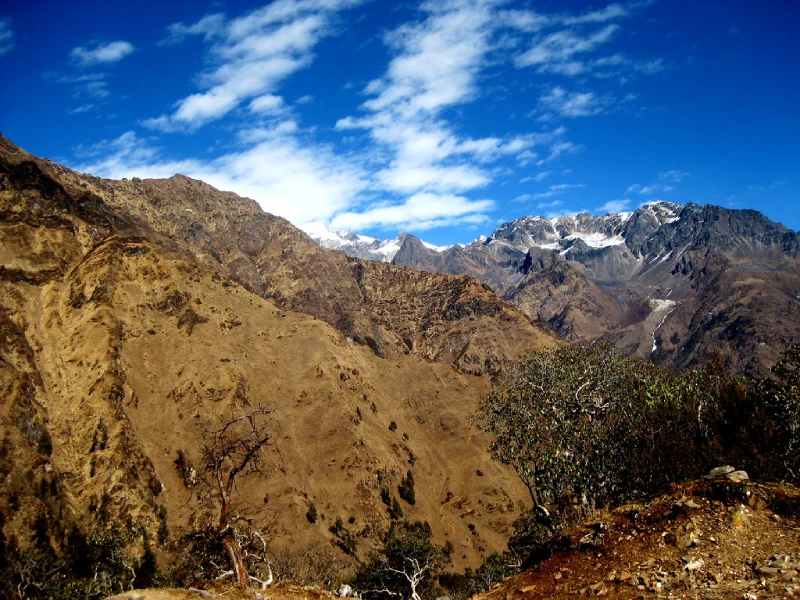
The trail includes forest trails, stone steps, and also rocky terrain as you advance. There will be some narrow and rough areas along the path, in particular around Pangsang Pass. Weather can affect the trail as well.
Altitude
The highest altitude on this trek is when crossing Pangsang Pass at an altitude of 3,850 meter. Although altitude sickness issues are minimal here, slow but stable progress will be crucial to success. Proper hydration and acclimatization take care of any risks.
We have planned a well-planned Ruby Valley Trek Package takes into account all of the above-mentioned factors, avoiding the difficult days with proper rest. This makes the entire trek a comfortable task, with no sense of hurrying throughout the journey.
Culture and Local communities
The Ruby Valley Trek is not all about viewing mountainous landscape. This trek provides a chance to explore places, which are deeply rooted in their cultural traditions.
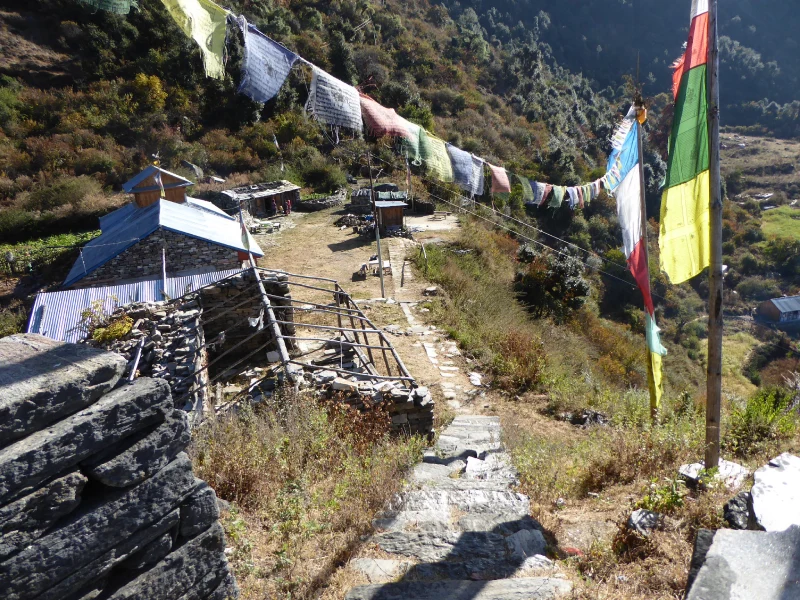
The tradition of Tamang community greatly influences the culture of the entire area. You can sense it at every step. Prayer flags sway in the village wind, and Buddhist prayers is heard from the monasteries nearby. A number of people in the villages still practice their ancient traditions, whether agricultural practices or dressing code.
Another rick cultural tradition on this path is the Gurung people and their communities. With a strong connection to the military of Nepal, the Gurungs have their own unique and distinct identity. If lucky, you might even witness some of the folk dances and music during the festivals.
If you Ruby Valley Trek falls within the time of some local festival, then you trek will definitely be much more interesting. Festival such as Lhosar can give you a unique experience, making you see how colorful, musical and entertaining these events are.
People in this area depend on farming, livestock and have strong family values. They wake up early and either go to their fields or take care of animals before sunrise. This lifestyle gives a different experience compared to city living.
These cultural features help to make your journey much more memorable.
Accommodation and Food
The Ruby Valley Trek is quite different from other trekking trails. There will not be any luxury hotel along the way, and you won’t even stay at tea houses regularly, instead you will stay in a homestay which is something much more interesting.
Most of the days you will have the opportunity to stay overnight at houses of local Tamang or Gurung families. Homestay accommodation is an integral part of Ruby valley trek package and give you chance to see how everyday life works. The rooms will be very simple with just basic need like bed, a warm blankets and shared bathrooms.
Some villages like Gatlang and Syabrubesi, provide small tea houses and lodges, where you can enjoy the standard accommodation while trekking. In such places, you will have private rooms, basic toilets and common space to relax.
The food served along the trail would be traditional Dal bhat – the main dish in Nepal and you will soon get used to it. The Dal bhat will be filling enough to provide you energy for the following day. In most of the lodges, noodle, soup and eggs can also be found.
Unfortunately, in the remote area, the bottled water is not always available. Most trekkers drink either the boiled water provided by the lodge or use purification tablets for the water taken from the streams.
Required Permits
The trekking through Ruby Valley needs some valid permits because it passes through some protected and restricted areas.
Ganesh Himal Conservation Permit
The trek is located within the conservation area. The entry into this particular conservation area needs some particular permit to ensure protection of wildlife, forest, and environment of the place you are going to walk.
Tims Card (Trekkers’ Information Management System)
The Tims card is needed for almost all treks and trails of Nepal. The purpose of it is to track all the trekker during the trek and ensure that the trekkers can get quick help in case of any emergency.
Restricted Area Permit
There are some restricted areas in the Ruby Valley Trek, close to Tibet border areas. This permit is very important for safe passage in the restricted areas.
Village Entry Fees
The villages along the route collect small fees for the maintenance of the trails and other community assets. The fees are relatively low, and they contribute to the economy of the region.
Handling permit can be quite confusing, particularly when you visit Nepal for the first time. This is precisely the reason why we at Epic Trek Nepal take care of every permit in your Ruby Valley Trek Package.
We take care of everything, from the paperwork to the processing of permits, and now you can relax and have fun with your Ruby Valley Trek Itinerary.
Safety Information
Safety on the Ruby Valley Trek Itinerary is a crucial aspect because of its remoteness. This is what you should keep in mind when setting out on this journey.
Licensed Guide
All the trek that is located in remote area must include licensed guide who have experience with the terrain. They help navigate the route, recognize the weather pattern and risk associated with altitude. Their presence is extremely necessary, particularly when trekking through challenging areas like Pangsang Pass.
Weather Condition
Weather is mountain is always unpredictable. There would be clear sky in the morning, while in the afternoon, it would become rainy and cold. This happens extremely fast, usually within a few hours. To avoid that check weather report and pack appropriate clothes.
Emergency evacuation
In case of emergencies, helicopters can evacuate you from any accessible locations on the itinerary. The guides have communication devices in order to contact and obtain the required assistance. This plan can bring great peace of mind when passing through the remote and mountainous regions of your Ruby Valley Trek Itinerary.
Travel Insurance
This is one thing you cannot do without in your trek journey. Travel insurance that covers high altitude trekking, medical emergencies and helicopter evacuation is mandatory for this trek. There are no other option and ignoring it would be very risky.
Communication Availability
Mobile network coverage is very limited in this trek and there are some areas where there is no connection at all. Some teahouses provide basic Wi-Fi services although the connectivity is fairly slow and unreliable in most places.
Preparing all these things in advance will make your trek much safer and enjoyable.
Frequently Asked Questions
This trek falls between moderate to challenging due to walking distance which can range from 6 to 8 hours, especially at Pangsang Pass which is undoubtedly the hardest part of the trek.
Pangsang Pass is the highest point of the trek. It lies on 3,842 meters of height above sea level.
The duration of the trek varies from 7 to 9 days approximately. It includes driving days from/to Kathmandu as well.
Experience is good to have but not mandatory at all. Fitness and determination play a much bigger role than experience itself.
You will need The Ganesh Himal Conservation Area Permit, TIMS card, and restricted areas permit to start the Ruby Valley Trek Package.
Absolutely yes! High altitude trekking and rescue insurance is mandatory for anyone planning a trip to the Ruby Valley. There is no other way out!
Homestay and teahouse will be your only options on the trek. But don’t worry, despite the looks, every Ruby Valley Trek Itinerary offers cozy accommodation.
Spring and fall offer the best conditions with the most stable climate and breathtaking mountain vistas.
Definitely yes, but only for those who are physically prepared and ready for any challenge that may come up ahead.
There will be no mobile coverage at all in remote places such as Somdang and Pangsang Pass.
They mostly serve Dal Bhat, noodles, soups, and some basic egg dishes at places. Homestay places serve fresh, locally sourced food.
Yes, Epic Trek Nepal manages all the required permits as part of your Ruby Valley Trek Package.
Layered clothing, hiking boots, sleeping bags, and some first aid equipment would suffice for the changing weather conditions.
Yes, the itinerary can be modified according to the fitness level, availability of time, and other factors including your special requirements.
The risk of altitude sickness is medium, especially near Pangsang Pass. With proper pacing and adequate hydration, the risk can be managed quite effectively.
Trip Reviews

Need Help? Talk to Expert
+977 9764792172