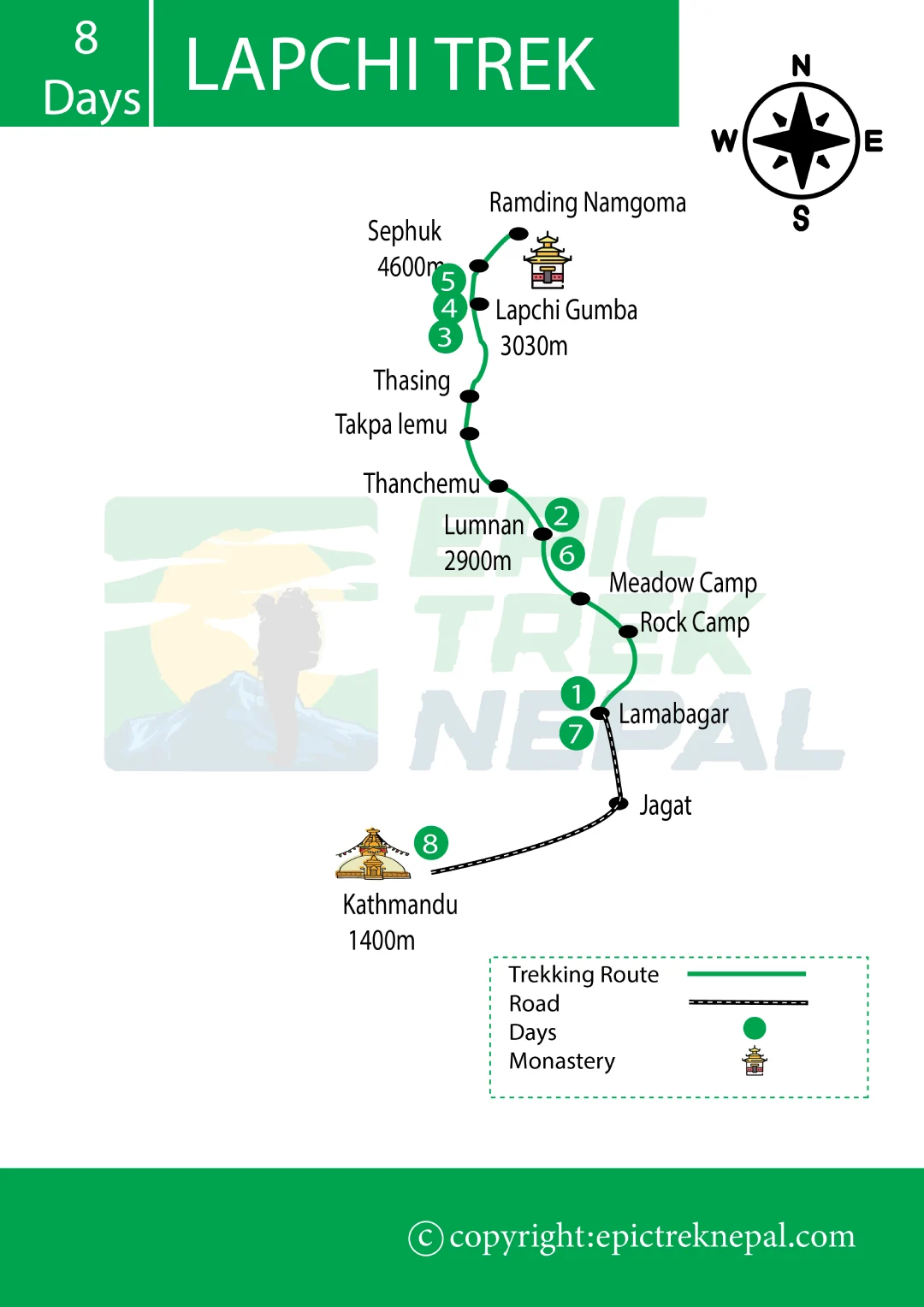
Route Overview of Lapchi Kang Milarepa Cave Trek
The Lapchi Trek begins with a long drive journey to Lamabagar located at 2077 meter. The journey will take approximately 7 to 10 hours, and the road condition gets more rougher the higher you move.
Once you have reached Lamabagar, the trekking begins. The trekking path will take you to Lumnan Village, at an altitude of 2900 meters. This path is along the forest trail of pine and rhododendron forest and involves a constant ascent.
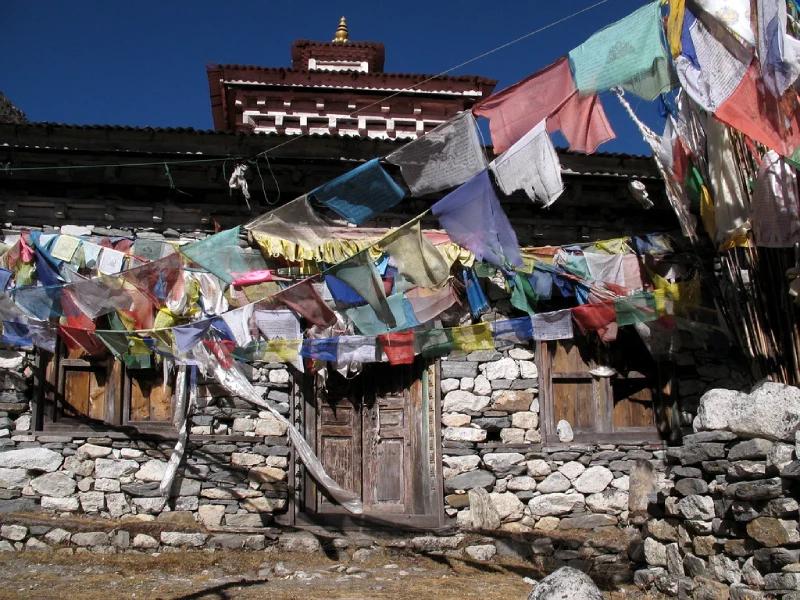
After Lumnan, the journey proceeds towards Lapchi Gumba, which is at 3030 meters. This Lapchi Trek route marks the beginning of the spiritual element of the trekking experience.
Once you reach Lapchi Gumba, you begin exploring the higher elevations with a trek to Sephuk at 4,600 meters. The thinning atmosphere and the expansive mountain scenery make this the toughest part of your entire Lapchi Trek Itinerary.
The next day takes you to the Lapchi Village and Lapchi Monastery. It will be a slower pace trek that allows you to enjoy the local culture and visit the meditation cave. After visiting this pace, it is time for the return journey. You go back from Lapchi to Lumnan and then Lumnan to Lamabagar, retracing the same routes but this time with different eyes.
At last, a lengthy drive takes you back from Lamabagar to Kathmandu.
Trek Difficulty
The Lapchi Trek is classified as a moderate level difficult which requires a basic level of fitness and definitely not the right choice for beginners. A good physical fitness is always great when you go for long trekking days.
For this trek, focus on physical activities like cardio exercise and strength training. Each walking days takes around 5 to 7 hours, sometimes even more on tough days. It is very important to go slowly and consistently than quickly.
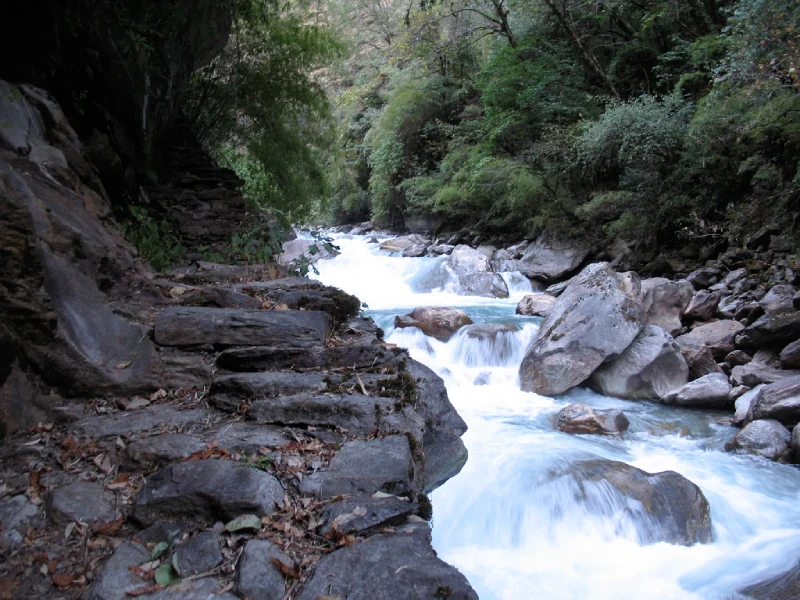
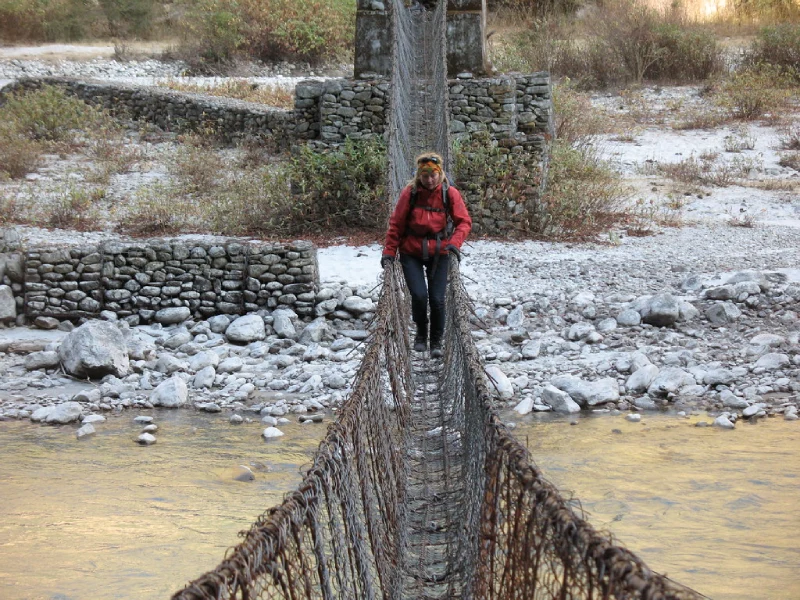
The terrain along the trail becomes very challenging as it changes from forest paths in the low parts of the trail to rocky and narrow paths in the high path of the trail. You will have to cross several rivers particularly around Lamabagar and Lumnan. In such areas, good balancing skills is very necessary.
High altitude makes trekking even more difficult after 3500 meters. Oxygen levels are reduced and breathing becomes difficult. At Sephuk, the altitude will be at least 4,600 meter and will be the most challenging high altitude trekking on the entire Lapchi trek route.
In the end, this trek is really worth the preparation. With good fitness levels and proper pacing, this trek can be easily handled without any technical mountaineering experience.
Preparation for the Lapchi Trek
Proper preparation plays a huge part in this trek as very few people use this trail; preparation should be very well.
First of all, make sure you train physically at least a month in advance. Training should include hiking in hilly region as well as cardio and weightlifting to develop proper stamina required for this trek.
After building some stamina, concentrate on choosing the right gear for the Lapchi Trek Package. Layered clothes is the way to go here due to extreme temperature changes in both forested and mountainous areas along the route.
Your boots are also extremely important and should not be skipped. Otherwise, you may have problems with blisters and foot pain ruining your great experience. You also definitely need a cold weather sleeping bag because accommodation along this trail is quite primitive and often without any heating.
Finally, do not forget about your backpack containing a basic kit of first aid supplies, some pills for purifying water and a decent headlamp. Also, extra batteries or a charger might come in handy.
Visa and Permit
Before starting the Lapchi Trek, ensure that you have all the necessary Nepal visa and permits. This will require some effort since the trek takes place in a far-away place.
For most of the tourists, there is the option of obtaining a Nepal visa upon arrival at Tribhuvan International Airport in Kathmandu. To obtain the visa, you will be required to have a passport valid for six months, passport sized picture, and visa fees that you can pay either in cash or credit.
After obtaining the visa, permits will be the next step. The Lapchi trek takes place in the restricted areas of the Nepal-Tibet border, and therefore, requires some additional permits.
Here, you will need to have a Restricted Area Permit, which can be arranged for you through trekking agencies. Individual trekkers cannot apply for this permit.
In addition, a National Park Entry Permit must be obtained as this path runs through restricted conservation land that has high biological diversity. A TIMS (Trekkers’ Information Management System) card will also be needed, primarily for safety reasons.
Language and Communication
The communication in the Lapchi Trek is quite unique compared to other busy trekking trails in Nepal. Because there are few trekkers in the area, the English is not common after leaving the Kathmandu city.
In Lamabagar and its neighboring villages, many of the locals speak either Nepali or Tibetan languages and not much English. There are also other local languages used in communication by the Sherpa settlements.
A trekking guide therefore becomes very important in such a situation, not only because of his role in navigation but also due to the need to communicate with the locals when it comes to arranging your meals, asking for information about the trails, or simply having a good conversation.
If you want to get to know the locals personally, knowing some basic words of the local language is sure to come in handy. For example, saying such phrases as “namaste” (hello), “dhanyabad” (thank you), and “kati ho?” (how much?) will get you far with that little smile in response.
In region near Tibet, there might be some Tibetan influences in terms of language in terms of language and traditions, especially near monasteries and the cave of Milarepa, where Buddhist chants will be heard. You do not have to understand the meaning of what is being said there, but listening to it is definitely an additional element of your trip.
Accommodation and Meals
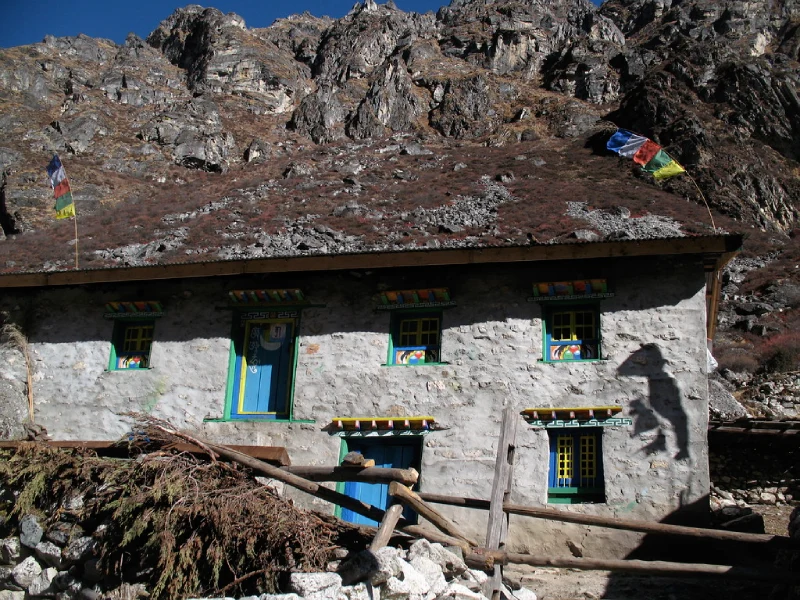
The accommodation on Lapchi Trek is very simple due to the remoteness of the trail. There won’t be any luxury hotel on this trail like you’d find on the Everest or Annapurna Trail.
In Kathmandu, during the beginning and end of your trekking experience, you will remain in 3 Star Hotel. This will provide you enough facilities and rest before trekking in the mountains. When the trek starts, the teahouses become your accommodation shelters. The rooms available at Lamabagar and Lumnan may be quite basic but still functional.
A little higher up, at Lapchi Gumba and Lapchi Village, there is going to be less choice of teahouse. There may even be a bit of camping at times, when there is not enough space at the teahouses. The trail is not used by many trekkers, so the facilities have not really developed compared to other trekking trails in Nepal. It is very important to carry a sleeping bag here, because it is cold at night.
The meals during the course of the trekking journey are focused on energy-rich in nature. You can expect to have dal bhat, noodles, soup, and simple pastas during this Lapchi Trek.
The breakfast includes items like porridge, eggs, or Tibetan bread to give sufficient energy for the upcoming walk of the day. Tea and coffee are easily available in this region as well, helping to survive the chilly mornings.
The higher up the mountains, the fewer the foods that will be available. The local foods and preserved supplies make up most of the meals after entering the Lapchi Kang Milarepa Cave Trek trail.
Overall, do not expect variety or comforts that are offered in mainstream trails. Embrace the humble food and accommodation that provides energy for one of the remotest treks in Nepal.
Mobile Network, Internet & Charging Facilities
On the Lapchi Trek do not hope for connectivity as the trekking route goes through one of the remotest areas. There is mobile coverage in Kathmandu and Lamabagar, and you can use it through Ntc and Ncell. However, outside Lamabagar, signals disappear entirely or become weak.
Once you start your trekking from Lumnan and Lapchi Gumba, you should not expect stable connection. There may be some spots that will give some weak signal, but they are unpredictable.
Internet facilties also become nonexistence throughout most of the route. There might be some teahouses on the way offering Wi-Fi, but the speed is very slow and unreliable. The farther from Kathmandu and Lamabagar one gets, the less chances one has of connecting to internet.
Charging facilities are no different as it is quite limited as you ascend. The lower teahouses provide charging facilities powered by solar which will cost few bucks for each device. Once you climb higher, there is no guarantee that the teahouse will have any means of charging your devices.
To avoid charging shortage, bring a portable power back with you and additional batteries for camera and headlamps. This unavailability of connections is exactly what makes Lapchi Trek Itinerary experience more authentic and genuine for many people.
Travel Insurance
For Lapchi Trek which is one of the remoted treks, travel insurance is not an option but an absolute necessary. This is because this trek goes above the altitude of 4,500 meter at Sephuk and in that high altitude anything can happen. Therefore, the insurance is a must which help to cover for the problem that might arise in high altitude trekking.
Be sure to check the height restriction on your insurance policy. Some policies cover only till 4000m or something close to that, which won’t quite work for you as the trek to Sephuk goes way beyond that. Make sure your insurance plan provides at least 5000m coverage.
Your insurance package must include helicopter evacuation and medical coverage for the treatment of altitude sickness and even hospitalization charges. Apart from the heli and medical insurance, it would be wise to arrange for trip cancellation and delay insurance, because the road condition to Lamabagar is not always predictable.





 Share
Share