Trek Difficulty
The Everest base camp trek by road is a bit difficult than a regular EBC trek. You just need to walk few extra days and it’s not that hard. It is not advance climb that require ropes, crampons or technical skills. But being physically fit is necessary.
There are three primary sources of the difficulty. First, the height of your journey, which causes cumulative fatigue over two weeks. Second, its length of 12 days, during which you will spend 6–8 hours per day walking. Finally, the rugged and sometimes even steep terrain, including rocky trails and high suspension bridges.
When you exceed 4,000 m in altitude, you might feel some effect such as headache, nausea, and shortness of breath due to altitude sickness. This is perfectly natural for all trekkers, but you should never ignore these early symptoms.
It is a bit difficult, but there is also extra acclimatization in this Everest Base Camp Trek by Road Itinerary, so your body can acclimate faster, and trek thought the whole journey comfortably and easily.
Preparation for the EBC Trek by Road
Preparation is vital before joining the EBC Trek by Road. It isn’t necessary to undergo intensive physical training, but having a strong foundation is important before doing this Ebc Trek by road.
Begin preparing eight to twelve weeks prior to the trip. The main focus should be on cardiovascular exercise that can make your body accustomed to the long walking hours, examples include hiking, stair climbing, cycling, and jogging. Ideally, do these activities three to five times per week. Hiking on weekends with a heavy backpack will also serve as good preparation.
Strengthening exercises for the legs and core are highly recommended. Squats, lunges, and step-ups are easy-to-do but very efficient leg strength exercises.
In addition, it’s important to prepare your equipment beforehand. First, you will need sturdy and already worn trekking shoes since blisters caused by uncomfortable footwear could make your Everest Base Camp trek by road a disaster. Thermal layers, down sleeping bag (rated at -10 Degree Celsius or lower), and good rain jackets are must-haves.
Also, the mental aspect should be taken into consideration. Prepare yourself for tough days, bad weather, and slow progress at altitude. Trekkers who go with realistic expectations usually have much better experience than those who go without them.
Visa And Permits
It is necessary to have the correct documents in hand prior to starting the trek to the Everest Base Camp via road. Thankfully, this process is very simple.
Nepal Tourist Visa
Almost all travelers can apply for the Nepal tourist visa on arrival in Tribhuvan International Airport in Kathmandu. You just need to have a valid passport, one passport-sized photograph, and the visa fee in cash form (USD is preferred). The 30-day visa will cost USD 50 while the 15-day visa will cost USD 30.
TIMS Card (Trekkers’ Information Management System)
All trekkers visiting Nepal must have the TIMS card. Individual trekkers must pay NPR 2000 while those trekking from a registered company will only pay NPR 1000. The TIMS card is important for monitoring trekkers’ information and their location in case anything goes wrong.
Sagarmatha National Park Permit
As you will be trekking in Sagarmatha National Park where Everest Base Camp is located, then you will need to have this permit. Each person needs to pay NPR 3000 (which is roughly equivalent to USD 25).
Pasang Lhamu Rural Municipality Permit
This permit lets you trek through the Pasang Lhamu Rural Municipality area, covering much of the upper Khumbu region and the trail to Base Camp. It will cost you NPR 2,000, about $15, per person. There are a few checkpoints along the way, so make sure to carry it with you. You’ll need to show it at these spots, so don’t leave home without it.
When booking through a registered trekking company like our “Epic Trek Nepal“, the permits are automatically arranged for you, so trekkers don’t have to worry and just enjoy the Everest Base Camp trek by Road.
Language and Communication
Nepal’s is the official language in Nepal, but you won’t struggle during the Everest Base Camp Trek by road. In the Kathmandu, most people speak English fluently and in Kumbu region, same as Kathmandu, most people speak English, especially shopkeepers, teahouse staff and lodge owner.
In lower Solu, between Thamdanda and Namche, English isn’t used as much. It can be harder to communicate with locals, that’s where hiring a guide really helps you from communicating to understand things better.
If you are travelling solo without a guide, carry a Nepali phrasebook or download a translation app before heading out from Kathmandu. While google translation can be useful for simple chats, there are some areas where internet is not available at all. So don’t depend on it completely.
Language barriers usually aren’t a big problem on this trek anyway. Everyone in the trekking community along the trail knows how to handle international visitors and will go out of their way to assist you
Mobile Network, Internet and Charging Facilities
Staying connected on the Ebc Trek by Road is possible, but don’t have high expectation. You will be going through the Himalayas, and you should set realistic expectation before heading out.
Mobile Network: There are mainly two networks provided: Nepal Telecom and Ncell. You can buy this from Kathmandu which will work in areas like Namche Bazaar, Tengboche, Dingboche and Gorak Shep too, but the signal can unpredictable.
Internet Access: Internet is available in most teahouses, but the speed is pretty slow and unreliable. It can only be use for sending text which can slow or updating someone and not fast enough for watching movies or making video calls.
To deal with this, some people bring portable WiFi devices or buy data SIM cards. These can be slightly reliable if staying connected is important for family updates or even work.
Charging facilities: As for charging your device, many offers charging facilities, but you will have to pay 1 to 3 dollars per device which also depend on how high you are. More height means more expensive on everything.
Don’t do on this trek
When you go on the Everest Base Camp trek by road, there are something that you need to keep in mind and move forward very precisely. So here are some key points that you need to consider twice:
- Don’t skip acclimatization day: If you don’t to return back mid journey, never skip the acclimatization day. Some people feel like acclimatization is like wasting time, but it is crucial to avoid altitude sickness. It allows your body to adjust to low oxygen area and help you trek better.
- Don’t litter on the trail: The Khumbu region has been facing huge garbage problem because of all the trekking throwing garbage around. So please, pack all the rubbish that you bring in a bag and toss it where it is allowed.
- Don’t touch or disturb religious monuments: Keep your hands off any religious monuments. For the sherpa community, things like Mani stones, prayer flags, stupa and monasteries are very sacred. Always walk in clockwise direction around stupas and mani walls and remember not to sit or touch anything in a disrespectful way.
- Don’t drink unfiltered water: The tap water or stream water along the trek can carry unwanted bacteria which can cause diarrhea or other problem. So always drink your purified, boiled or filtered water. Just in case bring water purification tablet.
- Don’t underestimate the weather: Mountain’s weather can switch moods in a flash, so equip yourself with rainwear, layers, and sunblock. Even if the sky is crystal clear when you start, be prepared.
Trek Extension
One of the best things about Everest Base Camp Trek by road is how it connects to other amazing spots in the Khumbu region. With some extra time, you can add extra destination to your main Ebc Trek by road.
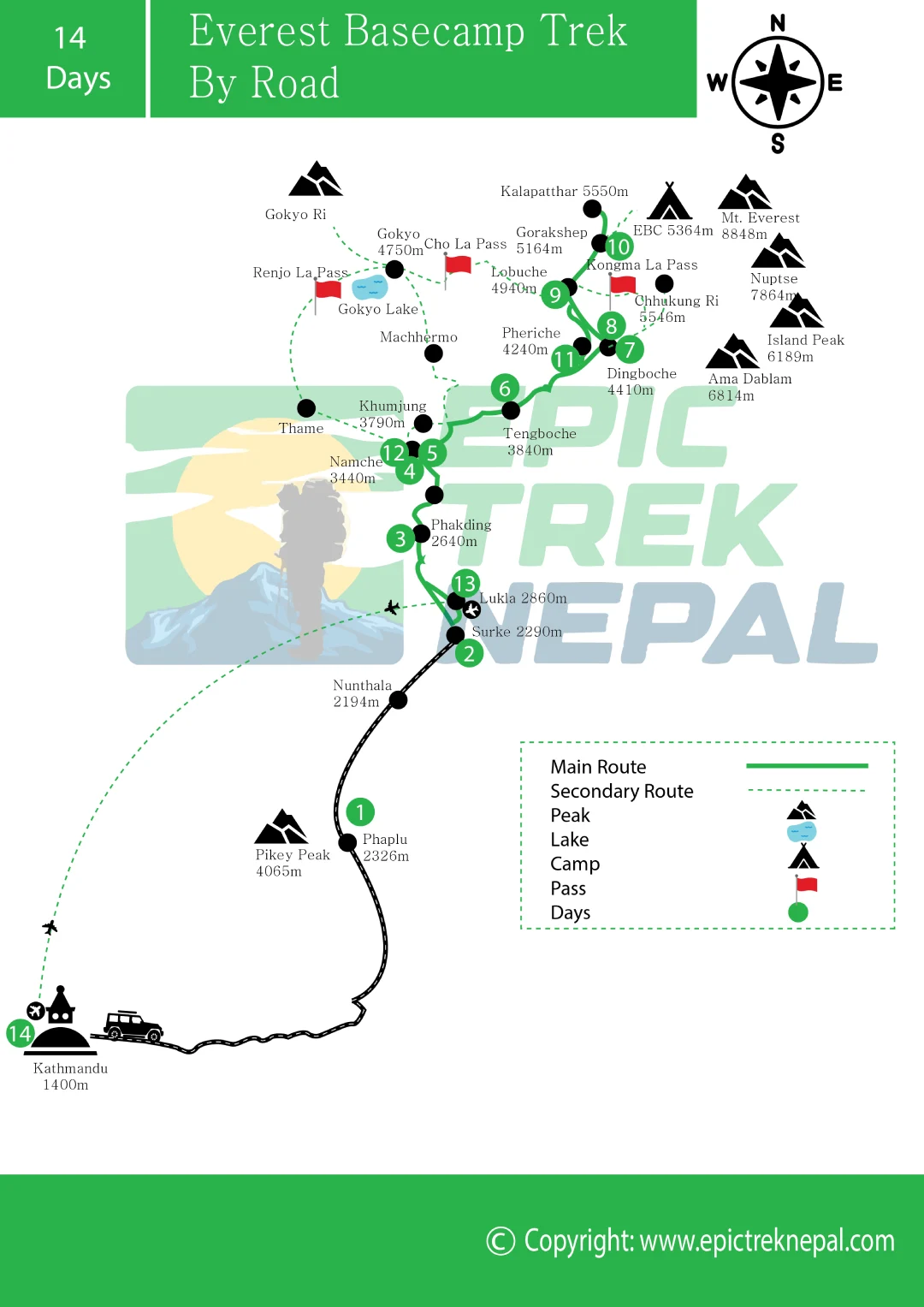
A major choice is the route to Gokyo Lakes and Gokyo Ri. Gokyo Lakes sit at around 4,700m, offering beautiful turquoise waters. Plus, scaling Gokyo Ri, which tops out at 5,357m, gives you a bird’s-eye view of four of the world’s highest mountains: Everest, Lhotse, Makalu, and Cho Oyu. Just know it’ll take 4-5 more days.
Another great option is the Three Pass Trek. It’s a bit difficult one and only for those who want a real adventure. It will let you cross Renjo La 5,360 m), Cho La (5,420 m) and Kongma La (5,535 m). It is like a loop covering the whole Khumbu region.
The Chola Pass to Gokyo provides a shorter but super scenic return option. Rather than going back the same way, you can cross the Chola Pass and head down into the Gokyo valley. This adds 2-3 days to your trip but show you to a whole new area on the way back.
Before setting foot on different trail for extra adventure, talk to your guide or trekking agency about this option. That way, sorting out permit, lodging and other details will be easy for Everest Base Camp Trek by Road Itinerary.
Travel Insurance
Travel insurance isn’t optional on the Everest base Camp Trek by road. Every trekker must have when trekking above 5,000 meters because there is real risk involved. Medical evacuation from the Khumbu region is insanely pricey without proper coverage. Trust me, you do not want to learn that the hard way.
So, make sure your plan explicitly covers high-altitude trekking. Many standard policies actually exclude these types of adventures, so be sure to check the details. Don’t just assume you’re protected because it claims to cover “adventure sports”.
Here the list what your travel insurance needs to cover.
- Emergency helicopter evacuations, these start at $5,000–$10,000 or more
- Medical treatment and hospitalization
- Trip cancellations or cut short trips
- Lost or stolen stuff
Health and Safety
Your health is super important on the EBC trek by road. Just few things can decide whether you will successfully reach the top or get evacuated early.
The biggest issue trekkers face is Altitude Sickness, or AMS, which starts kicking after crossing 3,000 meters. Symptoms like headaches, nausea, dizziness, tiredness, and bad sleep start to appear and to prevent this, hike up slowly, stay hydrated, and don’t skip those acclimatization days. If you feel worse, descend right away, AMS can turn dangerous fast if you ignore it.
Also, staying hydrated means, you have to drink tons of water, aim for 3 to 4 liters daily. Staying hydrated stops altitude sickness and fatigue. Avoid alcohol and caffeine, especially after Namche Bazaar.
Eat only freshly cooked meals at teahouses. The famous Dal bhat: a staple Nepali dish of rice and lentils keeps you full, healthy, and safe. You even get unlimited refills! But stay away from raw veggies, unpeeled fruits, and cold stuff.
On long treks, you typically deal with blisters, sunburn, tummy troubles, and respiratory issues. So, pack a basic first aid kit with blister pads, antiseptic cream, hydration salts, meds for diarrhea, and hefty SPF sunscreen.
Follow your guide’s advice, set your own speed, and let your ego alone. The mountains will be there no matter you reach fast or slow.





 Share
Share