How difficult is the Mardi Himal Yoga Trek
Mardi Himal Yoga trek is considered a moderate to difficult level mostly because of the altitude you have to trek on. On Mardi Himal Yoga Trek itinerary, it is an uphill hike without technical climbing but considerable elevation gain.
On average, you will have to walk 5 to 6 hours, maybe slightly more on the day that you climb up to base camp. The pace of hiking is slow, which allows combining physical activity with yoga practice.
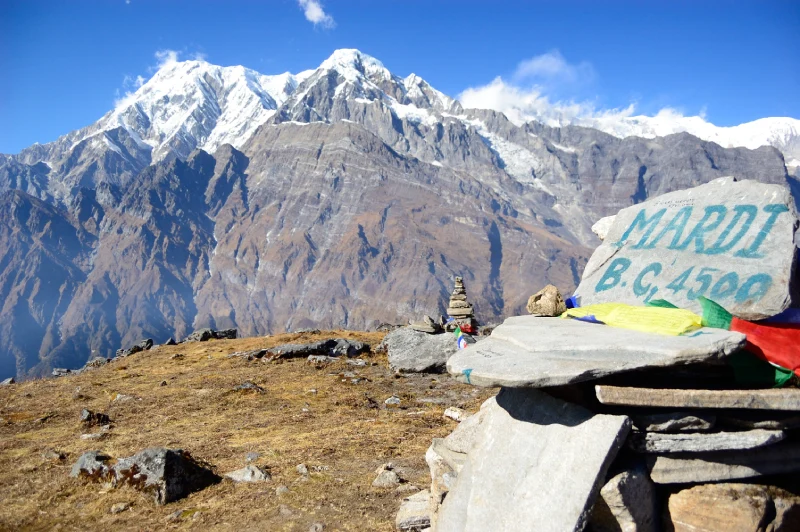
There will be plenty of ascents and descents, especially between Forest Camp and High Camp. The path will be clearly marked but it will be quite steep with stone steps and root-laden parts of the forest path. The highest altitude in which you will be sleeping is the High Camp at 3,580 meters and the highest altitude you can achieve is the Mardi Himal Base Camp at 4,500 meters.
Most of the time in peak season trails remain in good condition all along the way although they may become muddy or slippery after rains especially in the forest areas located at lower elevations. If that happens, proper footwear comes very handy in such situations.
Physical fitness is important, but you do not have to be an athlete. Engaging in regular physical exercise such as walking or hiking before the trek will help your knees and lungs through the trekking days.
Previous experience is not necessary either, since many people have successfully completed this Mardi Himal Trek with yoga without any problems as long as they take proper precautions.
Fitness and Preparation
Good preparation begins weeks before arriving in Kathmandu, not the night before the departure. There are some basic activities that help a lot with trekking.
Cardio is the priority. Regular walks, runs or cycling sessions three or four times per week develop endurance that will be needed during several days of walking in a row for Mardi Himal Yoga Trek. Uphill training is even more important than flat walking. If possible, make use of stairs, hills or an incline treadmill, you will feel their benefit while going from Forest Camp to High Camp.
It would be helpful if you tried doing some long-distance walks, preferably 10-15 km in a row before the expedition. It develops specific endurance that cannot be achieved by short workouts. Some strength training will come handy as well, focusing on leg and abdominal muscles. Squats, lunges and step-ups develop endurance of muscles absorbing impacts on a descent.
Make sure to break in your trekking shoes long before joining on the journey. It would be terrible to start your trekking in new shoes, which inevitably lead to the development of blisters.
Your hydration is of crucial importance not only at the height, but also while trekking there. Therefore, get into the habit of drinking water regularly, as dehydration makes altitude symptoms even worse. The gradual acclimatization process is part of the itinerary, but it will certainly go smoother if you come with a decent level of fitness already.
Preparation of the mind is as important as that of the body. Mardi Himal Yoga Trek requires lots of patience more than physical strength, which the yoga classes will assist you to develop.
Best Time for Mardi Himal Yoga Trek
Spring (March to May)
During spring, rhododendron forests will start blossoming along the low-level trails with their beautiful red and pink colors. Climbing will be generally favorable with good weather conditions: warm days and cool nights.
Mountains will be visible mostly in the mornings, but there can sometimes appear some clouds in the afternoon. Generally, this is the perfect time for combining trekking and yoga, with flowers, bird singing, and nice weather.
Autumn (September to November)
Autumn is traditionally called the best time for Mardi Himal Yoga Trek, and during that period weather will be relatively stable with good visibility of mountains in the Annapurna range.
In addition, this will be the busiest period of the year, so teahouses will be crowded, and you need need to book in advance to get nice rooms and have a good schedule for practicing yoga.
Winter (December to February)
Winters bring low temperatures, particularly in High Camp and Base Camp where nighttime temperature may go well below zero. Snowfall is common on the upper path, which sometimes makes walking difficult.
Monsoon (June to August)
During monsoon, it rains regularly and the path is generally muddy due to rainwater from the forest regions. Cloudy conditions prevent viewing of the mountains as visibility changes quickly in this period.
Permit required for Mardi Himal Trek with Yoga
Applying for the visa and permit for your Mardi Himal Yoga Trek package can be a very simple task, and it is advisable that you apply for them prior to your trip.
In case you are an international tourist, you can obtain the visa right away from the Tribhuvan International Airport in Kathmandu. There is yet another method to obtain your visa, which is to apply for it from the immigration website of Nepal. There are three kinds of visa validity, which are 15, 30, and 90 days. The best kind of visa to have for the trek would be a 15-day visa since you will spend only 12 days on the trek.
As far as permits are concerned about your Mardi Himal Yoga Trek, you will need two types of permits. First is the Annapurna Conservation Area Permit (ACAP), which costs about $30 USD. Second is the TIMS card, which stands for Trekkers’ Information Management System, and costs around $20 USD.
All these permits have been arranged for you by us “Epic Trek Nepal“. Now all you have to do is focus on your trekking. It is very important to carry these permits during the whole trekking journey. Staff at checkpoints may ask to show these permits.
Accommodation
In the beginning of the Mardi Himal Yoga Trek package, in both Kathmandu and Pokhara, you will be accommodated in cozy hotels with private rooms, en-suite bathrooms, hot showers, and wi-fi connection.
During the actual trekking part, accommodations change to teahouses and small lodges, and the rooms become more basic with twin beds, bathroom (shared or basic), and sufficient space for luggage.
The availability of a private room is possible during Mardi Himal Yoga Trek as the route has less crowds compared to other Annapurna routes. Nevertheless, depending on the time, especially in autumn, it might not always be possible to have a private room.
Most of the teahouses have hot showers, although sometimes they have additional charges and lower temperature at High Camp due to the height. Electricity is available, but solar energy is used and electricity will need more time to charge a phone or camera than it usually takes at home.
Wi-Fi access is unreliable. Wi-Fi is only available at some teahouses at an extra cost, but as the height increases, connections become worse.
Food and Drinking Water
Food on the Mardi Himal Yoga Trek itinerary has a similar routine: breakfast, lunch, and dinner, provided by teahouses on the way. The choice is straightforward but nutritious; the menu consists of foods that are easy to make at the elevation.
The meals during the trek are dal bhat, noodles, soups, pancakes, porridge, and momos. Dal bhat still continues to be the local specialty since lodges give free refills of dal bhat to trekkers on walking days.
Vegetarian food is easy to find and order; there are no issues with special diets, if you inform your guide about it before the trip.
Drinking water can be bought at the most lodges in bottles, however, the prices increase with the altitude. It is recommended to drink purified water or even filtered water, refilling a bottle instead of buying new bottles to avoid using too many plastic bottles.
Water purification tablets or filters would give some extra security in case of water at the high-altitude camp. Drinking enough amount of water becomes essential due to increased sensitivity to altitude sickness in the dehydrated body.
Don’t do on this Trip
Each great trip has its own set of rules to follow. While obeying these unwritten rules can be perceived as respecting the place you visit, following them will help you to stay safe, environmentally friendly, and have more fun during your Mardi Himal Yoga Trek.
Do not try to hurry. This itinerary was carefully prepared so that you could get enough time to adjust to the altitude conditions. If you try to rush and push yourself too much during the climbing days, you will put yourself in the serious danger of getting altitude sickness.
Do not litter. Annapurna Conservation Area is a protected territory and you should obey the rules here. Littering here is strictly prohibited. It is really sad to do it because plastic bottles do a lot of damage to the mountainous environment.
Don’t ignore any altitude sickness. While headaches are normal at the beginning of your trekking process, you shouldn’t overlook them as altitude sicknesses can happen in a very short time. So, don’t hesitate to share your feelings with your guide at Mardi Himal Base Camp.
Never drink untreated water. This can be very risky when it comes to drinking water. The issue is that while the water looks clear and fresh, taking it without proper treatment means getting severe diarrhea.
Weather conditions can change unpredictably in a few seconds once you get to high altitudes. Make sure you have your rain jacket and protective clothes even if you had the most beautiful weather in the morning.
Do not be disrespectful towards the local culture. The proper behavior is dressing decently, particularly in villages. Moreover, do not be afraid to ask for permission to take their photos. Also, remember to take off your shoes when entering monasteries or people’s houses if they ask you.
Travel Insurance
It is important to have the proper travel insurance while trekking Mardi Himal Yoga Trek package
First, your insurance policy should cover the height of 5,000 meters. The thing is that there are several very popular policies, which do not include the trekkers’ protection during the hike at the height. You definitely shouldn’t think that yours does. Your policy should have information about trekking or else you’ll be in trouble later.
Helicopter evacuation is the most important concern for any insurance cover in connection with Mardi Himal trekking. In the event of an accident, whether that is illness, injury, or altitude sickness, you would definitely need to be rescued immediately. The cost of these facilities in Nepal can normally cost thousands of dollar except if taken care of by the insurance package.
Insurance coverage for the treatment will also prove to be equally important. It is imperative that you get your insurance coverage for the hospitalization costs, the costs of medication, and evacuation in case of serious health problems.
It is necessary that you show the documentation of your insurance policy to your guide before commencing the Mardi Himal Yoga Trek package.






 Share
Share